Download
1 / 10
100 likes | 215 Vues
This document explores the subdivision of arbitrary meshes using the Catmull-Clark method, focusing on constructing dual meshes with vertices of valence 4. It emphasizes chart creation for vertices, edges, and faces, addressing overlaps and adjacent elements. The paper discusses transition functions for affine and projective transformations, particularly the benefits of three-chart blends over two. It highlights the implications of the co-cycle condition, the embedding of functions, and the challenges of blending composition functions. Presented at SIGGRAPH 2006, this research aims to improve overlap maximization in mesh geometry.

E N D
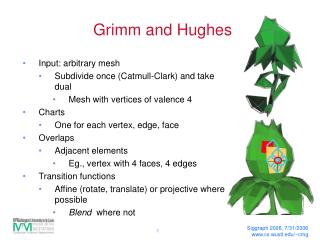
Grimm and Hughes • Input: arbitrary mesh • Subdivide once (Catmull-Clark) and take dual • Mesh with vertices of valence 4 • Charts • One for each vertex, edge, face • Overlaps • Adjacent elements • Eg., vertex with 4 faces, 4 edges • Transition functions • Affine (rotate, translate) or projective where possible • Blend where not Siggraph 2006, 7/31/2006 www.cs.wustl.edu/~cmg
Motivation • Maximize overlap • Three chart blend better than two • Co-cycle condition made > 3 hard • Affine transformations • (we got close) • Generalize spline construction process • Blend functions, not points Siggraph 2006, 7/31/2006 www.cs.wustl.edu/~cmg
Charts • Vertex: Square • Always valence 4 • Edge: Diamond • Diamond shape determined by number of sides of adjacent faces • Face: N-sided unit polygon • Shrunk slightly Siggraph 2006, 7/31/2006 www.cs.wustl.edu/~cmg
Overlaps • Vertex-face: corners • Vertex-edge: wedges • Edge-face: triangle • Edge-vertex: wedges • Face-vertex: corner quad • Face-edge: triangle Siggraph 2006, 7/31/2006 www.cs.wustl.edu/~cmg
Transition functions • Edge-face: Affine • Translate, rotate, translate • Face-vertex: Projective • Square->quadrilateral • Edge-vertex: Composition Siggraph 2006, 7/31/2006 www.cs.wustl.edu/~cmg
Transition functions • Edge-vertex: Blend transition functions Siggraph 2006, 7/31/2006 www.cs.wustl.edu/~cmg
Transition functions • C¥ continuous everywhere except blend area • Ck in blend area (determined by blend function) • At most three charts overlap anywhere • Reflexive: Use identity function • Symmetric: E-F, V-F both invertible • Co-cycle condition satisfied by blend function Siggraph 2006, 7/31/2006 www.cs.wustl.edu/~cmg
Adding geometry • Blend function per chart • “Bump” covering chart • Partition of unity by dividing by sum of overlapping • Embed function is a spline • Fit to subdivision surface • 1-1 correspondence between manifold and dual mesh Siggraph 2006, 7/31/2006 www.cs.wustl.edu/~cmg
Plusses • Embed functions simple, well-behaved • Three-chart overlap • Transition functions (mostly) simple • Locality Siggraph 2006, 7/31/2006 www.cs.wustl.edu/~cmg
Minuses • Blending composition function is ugly • Difficult to analyze • Large number of charts Siggraph 2006, 7/31/2006 www.cs.wustl.edu/~cmg