Download
1 / 7
70 likes | 209 Vues
This study analyzes the contribution of ultra-peripheral collision (UPC) electrons to pileup effects in high-energy physics experiments. By examining the transverse momentum (Pt) of electrons in the range of 0 < Pt < 0.5, we generate a data file containing the number of electrons per bin. This file serves as input for STARsim simulations, which model the behavior of particles in specific geometries. Preliminary results indicate that the contribution of UPC electrons at very low Pt (<0.1) is significant, and we plan to conduct additional simulations to further explore their effects.

E N D
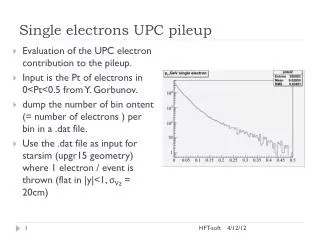
Single electrons UPC pileup • Evaluation of the UPC electron contribution to the pileup. • Input is the Pt of electrons in 0<Pt<0.5 from Y. Gorbunov. • dump the number of bin ontent(= number of electrons ) per bin in a .dat file. • Use the .dat file as input for starsim (upgr15 geometry) where 1 electron / event is thrown (flat in |y|<1, σVz = 20cm) HFT-soft
Pt input Tracks with no pixel hits remove # of hits in layer1,2 Effective Pt divide Excess in hits HFT-soft
# of hits in inner layer vs. PT of associated tracks input # of hits in outer layer vs. PT of associated tracks Pt of tracks with no pixel hits HFT-soft
comments • Contribution at very low Pt (<.1) of extra hits due to UPC electrons is not negligible • For higher Pt, we found back a ratio ~1, meaning 1 track leaves 1 hit in each layer. • To do : simulations with rapidity |y|<5 because even for vertex ~30cm, UPC electrons can hit the PXL detector. HFT-soft
Zoomed in 0 < Pt < 0.1 HFT-soft
“Loopers” in TPC HFT-soft