Understanding the Global Burden of Non-Communicable and Neglected Tropical Diseases
This course delves into the global burden of disease, focusing on Non-Communicable Diseases (NCDs) and Neglected Tropical Diseases (NTDs). It discusses the historical context of disease classification from the Bertillon Classification to the modern ICD systems, and highlights the findings from the Global Burden of Disease (GBD) studies. Emphasizing the importance of these classifications, the course advocates for transparent health financing and resource allocation, addressing how disease groupings impact advocacy and health outcomes.

Understanding the Global Burden of Non-Communicable and Neglected Tropical Diseases
E N D
Presentation Transcript
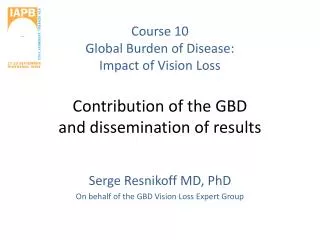
Course 17:NCDs & NTDsIntroduction:The Global Burden of Disease and the Rationale for Disease Groupings Serge Resnikoff MD, PhD
Classification of Diseases 1893: “Bertillon Classification of Causes of Death” – 161 titles 10 yr. interval ICD-6: WHO, 1946 ICD-9: 1975 (17,000 codes) ICD-10: 1983 (155,000 codes)
GBD • Initiated in 1992 • 107 causes of mortality and disability (diseases and injuries) • 10 risk factors • GBD 2004: last published • GBD 2010: 400 causes GBD 2001 (2006)
GBD 2004 * Group I: Communicable, Maternal, Perinatal and Nutritional conditions Group II: Noncommunicable conditions Group III: Injuries * Eye/Vision-related * * “NCDs” * “NTDs” * * * * *
Leading Causes of Burden of Diseases, 2004 HIV + TB + Malaria 3.8 + 2.2 + 2.2 = 8.2% NCDs = 16.6% Isch.HD + Cer.VD + COPD + Diab + Cancer 4.1 + 3.1 + 2.0 + 1.3 + 5.1 NTDs = 2.2% 0.2+0.1+0.2+0.2+0.7+0.05+0.02+0.1+0.2+0.2+0.1+0.1 Eye/Vision: 4.1%
Rationale for Disease Grouping • To measure the “True” burden • Mainly for Advocacy purpose “My group is bigger than your group” “I deserve more resources”
Misfinancing global health: a case for transparency in disbursements and decision makingDevi Sridhar, RajaieBatniji, Lancet 2008 Visual Impairment *