Electrochemistry - Battery cells
This text delves into electrochemistry, focusing on battery cells and the reactivity of metals. It explores displacement reactions, outlining how more reactive metals can displace less reactive metal ions in solutions. We analyze half-reactions related to copper, zinc, and other metals, explaining oxidation and reduction processes along with the construction of half-cells. The role of electrodes and the importance of a salt bridge for ion flow between half-cells are also discussed, providing a comprehensive look at fundamental electrochemical principles.

Electrochemistry - Battery cells
E N D
Presentation Transcript
Electrochemistry - Battery cells Sec 4 Chemistry 2010
Metals of the reactivity series Arrange the highlighted metals according to their reactivity.
Displacement Reactions • More reactive metal (Cu) + Less reactive metal ion (Ag+)
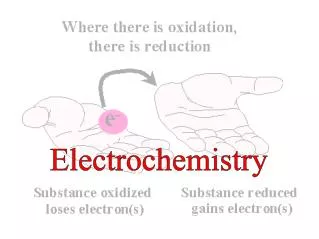
Displacement Reactions K Cu(s) + Ag+ Cu2+ + Ag(s) Na Ca Mg oxidation Cu(s) Cu2+ + 2e- Al Zn reduction Fe e- + Ag+ Ag(s) Sn Pb Half-reactions Cu Ag Au
Displacement Reactions K Zn(s) + Cu2+ Cu(s) + Zn2+ Na Ca Mg oxidation Zn(s) Zn2+ + 2e- Al Zn reduction Fe 2e- + Cu2+ Cu(s) Sn Pb Half-reactions Cu Ag Au
Zn e- Cu2+ e- e- e- e- Half-reactions Oxidation: Zn Zn2++ 2e- Reduction: Cu2++ 2e- Cu
Cu2+ Electrodes Electrodes Doesn't react with Cu2+, e.g. Cu Zn Doesn't react with Zn, e.g. Zn2+ A half-cell
Half-cells • A half-cell contains half of the redox reaction. • The anode is where the oxidation half-reaction takes place. • The cathodeis where the reduction half-reaction takes place. • What properties must the two electrodes have? • Note: by convention, we draw the anode half-cell on the left hand side.
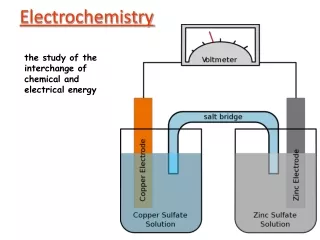
e- e- ? cathode anode ? reduction oxidation Cu2++ 2e- Cu Zn Zn2++ 2e- Is the circuit complete? Cu Zn Cu2+ Zn2+
The salt bridge • Allows the flow of ions between the two half-cells. • Consists of an electrolyte: • Doesn't react with the chemical reagents in the cell. • Example: NaNO3 or KNO3
e- e- ? cathode anode salt bridge ? reduction oxidation The salt bridge anions (A-) Cu Zn cations (C+) Cu2+ Zn2+