Exploring Consciousness and Cognition: Insights from Neuropsychology
100 likes | 135 Vues
Delve into the intricate workings of consciousness and cognition as they relate to brain functions and behaviors. Learn about the brain regions responsible for alertness, memory, decision-making, and self-awareness. Understand how brain injuries impact consciousness and explore fascinating studies on infants and animals' cognitive abilities. Gain insights into brain dynamics and the interconnected nature of cognition and consciousness.


Exploring Consciousness and Cognition: Insights from Neuropsychology
E N D
Presentation Transcript
Consciousness and Cognition Chris Lamonde Mr. Chessman Nov. 30, 2005 Hnrs. Bio II
Introduction • Try to think of nothing – it’s hard • Your mind will start to wonder with feelings, ideas, or anything important to you • Is a difference between your personal experiences and experiences • These operations happen at the prefrontal lobes of the brain (Lights Up)
Conditions of Consciousness • 1st is being awake/alert • The AFR ( ascending reticular formation) is a network of neurological circuits located in the core of the brainstem and extending upward from the medulla to the cortex • Those neurons transfer and manufacture neurotransmitters • Main purpose of this area is to keep you awake and alert • 2nd is being able to adapt to our surroundings • This is responding in countless situations that are unfamiliar • Need to make choices/decisions
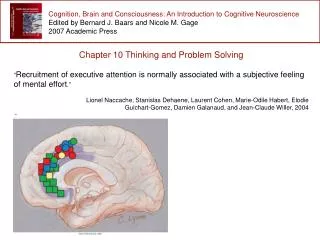
What parts of the brain do for our consciousness • AFR enables you to wake up • Hippocampus enables you to remember • Frontal lobes give you perspective and separation between internal and external events • Anterior Cingulate enables you to focus and concentrate
Injury that effects consciousness • Brain injury can effect consciousness in 2 ways • Mild – decease in alertness and wakefulness • Severe – deep and irreversible coma • People may become unaware and deny their injury • People may develop amnesia • Therefore the brain, mind, and consciousness are closely connected
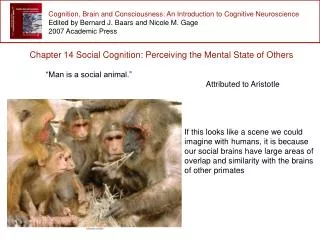
Relating Infants and Animals • Tests done to babies that put a rouge on their faces and then were put in front of a mirror • Children less than a year did move • Children 15-18 months would move their hand toward the spot • Children 2-3 years old would touch • Monkeys would acknowledge themselves in the mirrors • Chimps moved toward the rogue like the 15-18 month olds
Animals with each other • Baboons recognize cries of other baboons • They also understand their family relationships and place in the community • One chimp knew where food was and another that did not know followed him around • The chimp that knew where food was misled the other to places where the food wasn’t • Another called it’s mother to chase away another female so he could steal the food
More about the brain • Attention, memory, and sensorimotor coordination are not located in just one single part of the brain • Left hemisphere is more involved than the right • Language is located in the left • Language is a very important part in our understanding of consciousness
Dynamics of the brain • One brain wave ever 12.5 milliseconds • 40 cycles-per-second • Occurs between thalamus and cortex • Neurons work together and in rhythm
Conclusion • Cognition enables you not think about new things rather than things learned and in memory • Consciousness deals with new experiences, ideas and information • The brain and mind form a unity but, knowledge about them rely upon our own intangible ideas of consciousness