Download
1 / 1
10 likes | 128 Vues
This study investigates the effects of sodium chloride (NaCl) on the zero-shear-rate viscosity and scaling behavior of polyelectrolytes in solution. Key critical concentrations are explored, revealing significant changes with NaCl addition, including dramatic increases in c* and ce, alongside the disappearance of cD. Turbulent drag reduction experiments demonstrate that a homogeneous xanthan solution can achieve drag reductions of up to 37%. Notably, diluting an entangled xanthan stock solution enhances this reduction by threefold, providing insights into improved polymer efficiency in turbulent flows.

E N D
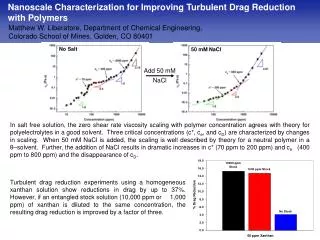
Nanoscale Characterization for Improving Turbulent Drag Reduction with Polymers Matthew W. Liberatore, Department of Chemical Engineering, Colorado School of Mines, Golden, CO 80401 No Salt 50 mM NaCl Add 50 mM NaCl In salt free solution, the zero shear rate viscosity scaling with polymer concentration agrees with theory for polyelectrolytes in a good solvent. Three critical concentrations (c*, ce, and cD) are characterized by changes in scaling. When 50 mM NaCl is added, the scaling is well described by theory for a neutral polymer in a θ–solvent. Further, the addition of NaCl results in dramatic increases in c* (70 ppm to 200 ppm) and ce (400 ppm to 800 ppm) and the disappearance of cD. Turbulent drag reduction experiments using a homogeneous xanthan solution show reductions in drag by up to 37%. However, if an entangled stock solution (10,000 ppm or 1,000 ppm) of xanthan is diluted to the same concentration, the resulting drag reduction is improved by a factor of three.