The Federal Structure and Political History of Argentina
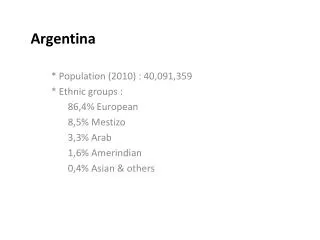
Argentina's population in 2010 was 40,091,359, comprised of diverse ethnic groups: 86.4% European, 8.5% Mestizo, among others. With 23 provinces and the Autonomous City of Buenos Aires, Argentina operates under a federal system where provinces maintain their own constitutions. This federalism arose from regional conflicts and economic needs. The country's political history is marked by cycles of democracy and military rule, notably the rise of Peronism under General Juan Perón. This rich tapestry of governance has profoundly influenced Argentina's social and economic landscape.

The Federal Structure and Political History of Argentina
E N D
Presentation Transcript
Argentina * Population (2010) : 40,091,359 * Ethnicgroups : 86,4% European 8,5% Mestizo 3,3% Arab 1,6% Amerindian 0,4% Asian & others
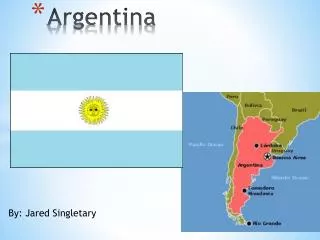
*23 Provinces *Buenos Aires as autonomouscity
Thecityandtheprovinceshavetheirownconstitutions, but existunder a federal system • Theadministrativedivisions of theprovincesare • departments • municipalities • Exceptfor Buenos Aires province, which is dividedintopartidos • Thecity of Buenos Aires is dividedintocommunes
Origins of ArgentineFederalism • causes of nationalunification • decisiontoadopt a federal regime • degree of centralization Eachdimension has itsowncauses (Articleby E. L. Gibson & T. G. Falleti)
Union of separatesovereignorsemisovereignprovinceswasdrivenbymutualeconomicneeds, but thesebythemselvesdid not determine a federal outcome • Thechoice of a federal regimewasdeterminedbyinability of onepowerfulregiontoimposeitsdominionovertheothersthrough a unitaryproject. Federalismemergedonlyafterdecades of failedconstitutionalprojects, intermittentsecessionistchallengesandcontinuousmilitaryconflict. • Theemergence of a centralizedfederalismwastheoutcome of regionalconflicts in whichvictoriouselitesfrompoorprovincessought a strongandautonomouscentralgovernmetthatwouldpreventoneprovince’sdominionovertheothers in theunion.
History of Argentina • Colonialera in 16. century • Declaredindependence in 1816 • ConservativeelitesdominatedArgentinapoliticsthroughnominallydemocraticmeansuntil 1912 • Thecountry’sfirstfreeelectionwasconducted in 1916, but thepresidentwasoverthrownby a coup in 1930
Peronism • In 1946, General Juan Peron waselected as president • He created a populistmovementcalled “Peronism” • His wifeEvaplayed a centralpolitical role until her death in 1952 • Eve Peron Foundation • FemalePeronistParty • Women’ssuffrage in 1947
DuringPeron’stenure • Wagesandworkingconditionsimproved • Unionizationwasfostered • Strategicindustriesandserviceswerenationalized • However, stablepricesandexchangeratesaredisrupted • Foreignpolicybecamemoreisolationist • Censorshipandrepressionwereintensified • Coup in 1955 : He fledintoexile
In 1958 elections, Frondizicameintooffice • However, militaryinterferedbehalf of conservatismandagrarianinterest, forcedhimtoresign in 1962 • In 1963, IlliawaselectedandtriedtoincludePeroniststopolitical life • So, armedforcesretookpower in 1966, coup • New repressiveregimecaused Peron tocallbackbystudetandlaborprotests • Freeelectionsweredemandedand Peron cametopower in 1973
Peron died in 1974 andlefttheofficeto his thirdwifeIsabel Peron, thevicepresident • Conflictbetweenleft – rightextremist, ledtomayhemandfinancialchaos • Coupd’etat in 1976, whichremoved her fromtheoffice
Thisnewdictatorshipbrought • somestability • numerouspublicworks at first • But then, • deregulation of financeledtosharpfall in livingstandards • recordedforeigndept • deinstrialization • peso collepsed • corruption • finally in 1982 defeatbytheBritish in theFalklandsWar • Discreditedthemilitaryregimeandledtofreeelections in 1983
Ever since, therewereseveralcoupattemps in Argentina, but theyfailed • In 1987 againstPresidentAlfonsin • In 1988 againstPresidentAlfonsin, twotimes • In 1993 againstPresidentMenem • Because of economicproblemsandcorruption
Power sharing between the centre and the regions Federalism in Argentina
Republic is divided into provinces, municipalities and the Autonomous City of Buenos Aires → right to have its own constitution, has to respect the federal one (section 5) • 23 provinces • Federal government can intervene in the provinces in order to maintain peace.... (section 6)
The Congress • Bicameral legislative branch: Congress (Senado de la Nacion) and Chamber of Deputies (Cámara de Diputados de la Nación) • Both houses can introduce bills → send to the other House for debate → has to be accepted by the President • It can lever indirect takes in concurrence to the provinces • → an agreement-law regulates the partition of these taxes → “priority to the achievement of a similar degree of development, of living standards and equal opportunities throughout the national territory” • Direct taxes for a specified term throughout the territory
The Senate • Senators elected directly by the population (American model) • in the Congress 3 elected Senators from every region plus 3 from Buenos Aires City (section 54) • Vice-President also the President of the Senate → belongs to the Legislative (section 57) • Has to give consent if there is the wish to form new provinces out of the already existing provinces • The agreement-law has to be originate here → responsible for laws that concern the equality bewteen the provinces • Executive members are appointed with the its consent
Judiciary • Supreme Court and other national courts have the exclusive jurisdiction for all cases concerning one or more provinces • Federal judges aren't allowed to be provincial judges (section 34)
Provinces • Have all the powers that aren't delegated to the federation by the constitution • Can choose their own form of governance according to the national constitution
Argentina • Rich natural resources • Highlyliteratepopulation • Diversifiedindustry • Export-orientedagriculture • Seriouseconomiccrisis in thelate 19th century Historically, the Federal governmentwastheoneresponsibleforinternationaltradeandsub-nationalgovernmentsforlocaltaxes, however a shift in control of taxes on behalf of federal government has beenseenrecentlymainlywithCo-ParticipationLaw.
MAIN CHARACTERSTICS OF FISCAL FEDERALISM IN ARGENTINA • The most decentralized state in Latin America • Approx. half of total public spending at local level • Doubles institutional and political autonomy The problem: Sub-nationalgovernmentsblamedto be responsiblefordeficits. • Centralized tax collection • Redistribution of the tax revenue through intergovernmental transfers, causing a high vertical imbalance • The Commonwealth is responsiblefordistributing 56.66% of itsrevenuestoprovincesandretaining 42.44%. The rest is reservedfortheNationalTreasury. • Gap between the revenus andexpenditures of thesub-nationalgovernments Expenditures: 63% of allgovernmentexpenditures Revenues: 37.93% of allgovernmentrevenues equalledbytransfers • The fourrichestprovinces(Buenos Aires Province, Buenos Aires City, CordobaandSantaFe) arerecieving 40% of alltransferswhiletheeightpoorestrecievingapproximately 25%
Tax-SharingandIntergovernmentalTransfers Regulatedwith • Co-participationLaws • Distribution of resourcesbetweenthenationandprovinces • Solvingtheconflictsbetweenprovincesandmunicipalities • Transfer Service Laws • Financingeducationalservices
PROBLEMS • A “Labyrinth” ? - Complexity • Inefficiency • VerticalFiscalImbalance • Irresponsiblesub-national gov.s, as if no hard-budgetconstraint, duetolack of incentives, not enoughefforttocollecttaxeslocally • Bail-out problem, higherlevels of localgovernmentsbailsoutthelowerlevels – Moral Hazard • Lack of FinancialControl • Sub-national gov.s werefreetoborrowinternationallyuntil 1994, mighthaveresulted in instability, nowtheyneedtoget an approvalfromthenational gov. • UnfairRedistributiveOutcomes
References • http://www.isr.umich.edu/cps/pewpa/archive/archive_99/19990003.pdf • http://aysps.gsu.edu/econ/files/ECON_TaylorGregory_Argentina_summer07.pdf • http://dss.ucsd.edu/~ssaiegh/Economia.pdf