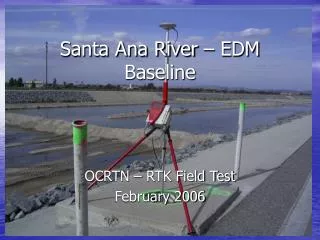
Santa Ana River – EDM Baseline
120 likes | 243 Vues
This report outlines a field test conducted in February 2006 along the Santa Ana River to assess RTK (Real-Time Kinematic) positioning accuracy between four stable monuments. The objectives included measuring horizontal distances and vertical differences, as well as positioning monuments using four different base stations with varying baseline lengths. Detailed methodologies involving independent occupations, measurement epochs, and equipment, such as the Leica SR530 receiver and AT502 antenna, are presented alongside the comparison of RTK and record measurements.


Santa Ana River – EDM Baseline
E N D
Presentation Transcript
Santa Ana River – EDM Baseline OCRTN – RTK Field Test February 2006
Objective: • To measure the horizontal distance and vertical difference between 4 stable monuments • To position monuments from 4 different Base Stations with different baseline lengths • Compare RTK measurements to record measurements
RTK Procedures • 2 Independent occupations on each station • Each independent occupation consists of two 50 epoch measurements (about 1 minute) • Independent occupations occur on different days and different times of the day (+/- 3 hours)
Equipment Used: • One Voodoo Stick • Leica SR530 receiver • Leica AT502 antenna • CDMA Airlink modem • Fixed 2 meter pole w/ 8’ bubble
# of Independent Occupations • Compare coordinates computed for each station and from each base station to the RTK average coordinate: Station OEOC(8.2 mi) WHYT(16.6 mi) SCMS(28.7 mi) CAT2(44.7 mi) A 2 2 2 2 B 2 2 1* 1* C 2 2 1* 1^ D 2 2 1* 2 Wait at least 3 minutes to achieve fix *= could not achieve fix on day 1 ^ = could not achieve fix on day 2
Relative - Test Results: • Compare Historic (record) horizontal distance and vertical difference to RTK coordinate differences for stations: Pt to Pt Record Horiz Dist (ft) Record Vert Diff (ft) A to B 371.967’ +0.977 B to C 2702.579’ +8.324 C to D 2769.172’ +10.895