Aerobic Cell Respiration - Review
340 likes | 470 Vues
This review on aerobic cellular respiration, authored by Luxi Nanthakumar and Andy Rambarack, explains the biochemical process through which glucose and oxygen are transformed into water, carbon dioxide, and energy in the form of ATP. We explore the significance of this metabolic process for life, how it works—from glycolysis in the cytoplasm to the Krebs cycle and electron transport chain in mitochondria—and the accounting of ATP produced. A vital insight for understanding energy conversion in biological organisms.


Aerobic Cell Respiration - Review
E N D
Presentation Transcript
Aerobic Cell Respiration - Review Luxi Nanthakumar, Andy Rambarack
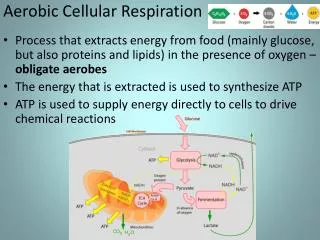
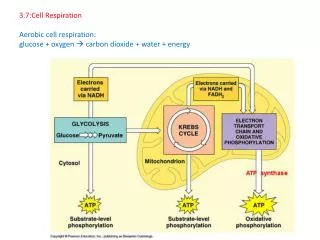
What is it? • C6H12O6 + 6O2 6H2O + 6CO2 + 36 ATP • Glucose + Oxygen Water + Carbon Dioxide • Metabolic reactions to convert nutrients into energy
Why is it important? • We eat glucose • Energy in the form of ATP is produced • Necessary for life
How does it work? • When we breathe air in…
How does it work? • When we eat food…
We get glucose! • C6H12O6
In the cytoplasm… • 6-carbon glucose is phosphorylated using ATP which turns into ADP ADP ADP ATP ATP P P
2 NAD+ molecules come to oxidize them NADH NADH NAD+ NAD+
4 ADP molecules dephosphorylate the 3-carbon sugar diphosphate ADP ADP ADP ADP
The phosphates break off, producing 4 ATP molecules ATP ATP ATP ATP
Transition step in mitochondria • Pyruvate is oxidized by NAD+ NADH NADH NAD+ NAD+
Oxygen molecules decarboxylate pyruvate, producing… O2 O2 CO2 CO2
Carbon dioxide and Acetyl-CoA! Coenzyme-A transports the Acetyl-CoA to the matrix
In the mitochondrial matrix • The 2-carbon chain connects to a 4-carbon molecule (oxaloacetate), making a 6-carbon chain (citrate) Coenzyme-A returns to pyruvate oxidation
In the Krebs cycle • Citrate is oxidized … twice! • Producing CO2 … twice! NAD+ NADH CO2
Remember it happens twice NAD+ NADH CO2
NAD+ and FAD are reduced, producing NADH and FADH2 NAD+ NADH FAD FADH2
Krebs cycle repeats • Because there were two pyruvate molecules
In the Inner Membrane of the mitochondria… • Electrons from NADH pass through 3 proteins Protein Complex II Protein Complex I Protein Complex III NADH
Electrons from FADH2pass through 2 proteins Protein Complex II Protein Complex I Protein Complex III FADH2
As electrons pass through, H+ ions pumped into inter-membrane space H+ H+ H+ H+ H+ Protein Complex
The H+ ions return through ATP synthase H+ H+ H+ H+ H+ ATP Synthase Protein Complex
ATP is produced as H+ ions pass through ATP synthase • Oxygen molecules combine with the electrons and protons to make water! H+ ATP Synthase ATP O2 H2O
Remember CO2 and H2O? CO2 H2O and are products of cellular respiration They are expelled from the body as waste
ATP Accounting • During glycolysis, 2 ATP molecules are used to phosphorylate glucose • Because the NADH molecules from glycolysis must enter the mitochondria from outside, it requires 1 ATP molecule each