Understanding the Respiratory System: Key Functions and Components
This lesson explores the vital components of the respiratory system, detailing how each part contributes to the process of breathing. Key elements include mucus's role in trapping harmful substances, the trachea's function in air transport, the larynx's housing of vocal cords, and the bronchioles leading to air sacs. It also examines how oxygen enters the blood while carbon dioxide is expelled, highlighting the interplay between the respiratory and circulatory systems. Additionally, it describes how breathing occurs through diaphragm and rib muscle movements.

Understanding the Respiratory System: Key Functions and Components
E N D
Presentation Transcript
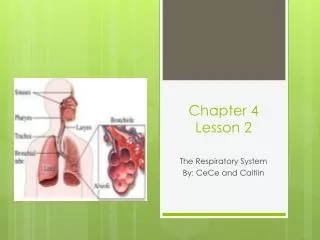
Chapter 4 Lesson 2 The Respiratory System By: CeCe and Caitlin
Parts of the respiratory system • Mucus:is a sticky, thick, fluid that traps dust, germs, and other harmful substances. • Trachea: is a tube that carries air from the Larynx. • Larynx : houses your vocal cords • Bronchioles : are the tubes that branch from your bronchi. They eventually end in air sacs. • Air sacs :are where oxygen enters the blood and carbon dioxide exits the blood. • Cilia : are tiny hair-like structures that clean air by waving rapidly.
respiratory and circulatory systems work together • All multicellular organisms need oxygen. • They need oxygen to release energy from glucose that cells need. • Air sacs and capillaries have an important job : they supply the blood with oxygen. • They do this by transporting carbon dioxide into the air sacs, when that happens oxygen takes its place in the blood stream.
Getting rid of carbon dioxide • When CO2 exits the blood. stream and enters the lungs, you breathe out, this how your body gets rid of CO2. • When you hold your breath, CO2 builds up in your blood. • your brain senses this and sends a message to the rib muscles and the diaphragm telling them to breathe. • In this way, several systems in your body work together to make sure your cells get oxygen.
How you breathe • When you inhale, your diaphragm contracts and moves down, making more space in your chest. • Your rib muscles may also pull your rib cage up and out, making still more space. • Air quickly rushes into the lungs and takes up these new spaces. • When your diaphragm and rib muscles relax, they push air out of the lungs.