Download
1 / 12
120 likes | 265 Vues
This resource introduces the essential properties of logarithms, including the product, quotient, and power properties. It provides examples of how to apply these properties to approximate logarithms and expand or condense logarithmic expressions. Through various exercises, you will learn to use the change of base formula and evaluate logarithms in both common and natural logarithm forms. Perfect for students seeking to understand logarithmic functions and their applications in mathematics.

E N D
Properties of logarithms Math 3 Keeper 29
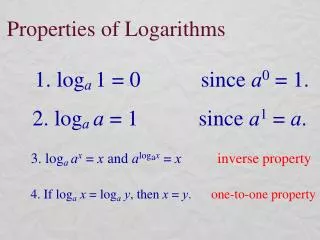
Properties of Logarithms • Let b, u, and v be positive numbers such that b≠1. • Product property: • logbuv = logbu + logbv • Quotient property: • logbu/v = logbu– logbv • Power property: • logbun = n logbu
EXAMPLE 1: Use log53≈.683 and log57≈1.209 to approximate the following: a) log53/7 = log53 – log57 ≈ 0.683 – 1.209 = -0.526 b) log521 = log5(3·7)= log53 + log57≈ 0.683 + 1.209 = 1.892
EXAMPLE 1 (continued): Use log53≈.683 and log57≈1.209 to approximate the following: c) log549 = log572 = 2 log57 ≈ 2(1.209)= 2.418
YOUR TURN!Use log95≈0.732 and log911≈1.091 to approximate the following: d) log95/11 e) log955 f) log925 d) -0.359 e) 1.823 f) 1.464
EXAMPLE 2: Expand the given logarithm *You can use the properties to expand logarithms. a) log2 = log27x3 - log2y = log27 + log2x3 – log2y = log27 + 3·log2x – log2y
Your turn! Expand the logarithm. b) log 5mn= log 5 + logm + logn c) log58x3 = log58 + 3·log5x
EXAMPLE 3: Condense the logarithms a) log 6 + 2 log2 – log 3 = log 6 + log 22 – log 3 = log (6·22) – log 3 = log = log 8
YOUR TURN AGAIN! Condense the logarithm. b) log57 + 3·log5t = log57t3 c) 3log2x – (log24 + log2y)= log2
Change of base formula: • u, b, and c are positive numbers with b≠1 and c≠1. Then: • logcu = • logcu = (base 10) • logcu = (base e)
EXAMPLE 4: Evaluate using the change-of-base formula using 1) common log & 2) natural logarithm. a1) log37 = log 7 ≈ log 3 0.8451 ≈ 0.4771 1.771 a2) ln 7≈ ln 3 1.946 ≈ 1.099 1.771
EXAMPLE 4 (continued): Evaluate using the change-of-base formula using 1) common log & 2) natural logarithm. b1) log48 = log 8 ≈ log 4 0.903 ≈ 0.602 1.500 a2) ln 8≈ ln 4 2.079 ≈ 1.386 1.500