Download
1 / 17
170 likes | 287 Vues
This project outlines a detailed strategy to assess and prioritize 34 estates based on their regeneration needs. Key initiatives include categorizing estates into bands, developing design interventions that surpass Decent Homes standards, and identifying potential development opportunities. A 5-year regeneration strategy will be created incorporating community engagement through focus groups, interviews, and surveys. Each estate will be evaluated on various performance indicators with a scoring system to guide prioritization, ensuring optimal allocation of resources for urban renewal.

E N D
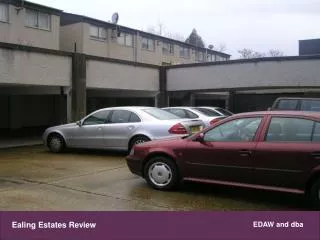
The Brief • Prioritise 34 estates into ‘bands’ of regeneration need/potential • Develop design interventions for priority estates (above and beyond Decent Homes) • Identify potential development opportunties • Cost these solutions (high level) • Develop a 5 year strategy of regeneration
Methodology 1. Estate Appraisal Criteria 2. Urban Design and Delivery
Basic Principles • Neighbourhood Performance Indicators • 4 Housing • 4 Regeneration • Scoring 1-5 (1 poor, 5 good) • Traffic Light System • Red (0 to 2) • Amber (2.1 to 2.9) • Green (3 to 5) • Prioritisation through Banding
SG1 - Visual and Data Review • Visual Assessment of 34 estates • Data review of housing statistics • Stock condition • Transfers • Tenant/Leaseholder Mix • Data review of socio-economic statistics • Results set out over the 8 Neighbourhood Indicators • Each indicator scored and traffic lighted
SG2 - Officer Interviews • Reality check for Stage 1 • Interview with Ealing Homes Asset Management • Interviews with Estate Management • Set out against the 8 Neighbourhood Performance Indicators • Scored and traffic lighted
SG3 - Community Engagement • Community Focus Groups with all known Estate Reps invited • Sessions held for Northolt & Southall, Acton and Ealing & Hanwell areas • Traffic light and scoring exercises against 8 Neighbourhood Performance Indicators • Residents Survey posted to all homes
Neighbourhood Performance Indicator - An Example Baseline Housing Quality Housing Management Housing Diversity Estate Potential Open Space & Public Realm Quality Environmental Sustainability Public Transport Socio-Economic Indicators
Banding Estates • A range of bands will be developed within which each of the 34 estates will be placed • Bands will developed in response to the findings • For example banding could be based on estates where there is • High Level Intervention • Medium Level Intervention • Low Level Intervention
Methodology Urban Design and Delivery
Costing and Delivery • Costs will be based on the following outputs proposed through the urban design stage: • Residential • Number of replacement homes • Total homes provided • Non residential uses to be delivered • Public Open Space • Public Realm Improvements
Costing and Delivery • Assumptions: • Indicative land value to be agreed • Social Housing Grant – at typical London levels • Baseline without cross-subsidy • Needs detailed modelling • Match/gap with Decent Homes budget to be reviewed • Indicative delivery arrangements to be agreed • 100% replacement of current affordable homes • Affordable housing planning policy for all additional homes
Neighbourhood Performance Indicator – An Example Housing Quality Housing Management Housing Diversity Estate Potential Open Space & Public Realm Quality Environmental Sustainability Public Transport Socio-Economic Indicators
Next Steps • Final report to February Cabinet • Cabinet to agree future direction of estates informed by recommendations • Detailed feasibility work and development briefs to be worked up based on Cabinet decisions