Optimizing Distances and Costs in Real-World Scenarios
60 likes | 185 Vues
This resource covers the methodology for determining the shortest distance from a graph to the closest point, specifically analyzing the curve y = √x and a point (4,0). Additionally, practice problems focus on optimizing travel time for an athlete swimming from an island to the shore and then running to a rest station, as well as minimizing costs for a power company laying cable from a shore-based power plant to a buoy in a lake. The mathematical principles of distance minimization and cost optimization are explored in practical applications.


Optimizing Distances and Costs in Real-World Scenarios
E N D
Presentation Transcript
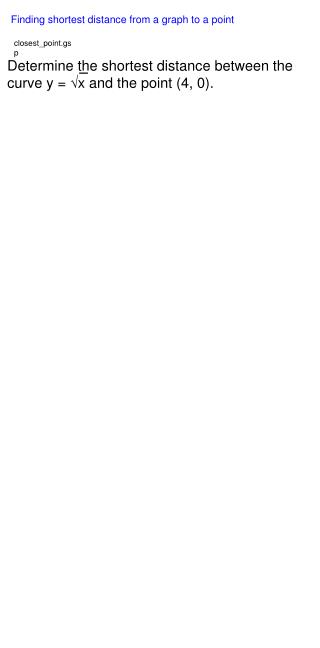
Finding shortest distance from a graph to a point closest_point.gsp Determine the shortest distance between the curve y = √x and the point (4, 0).
Solving a problem that minimizes time swim to the shore then run.gsp An athlete needs to travel from an island, which is located 2 miles from the shore, to mainland, then to a rest station which is located 3 miles along the shore from the island and 1 mile inland. Calculate the minimum time required to complete this trip if the athlete can swim at 2 mph and walk at 4 mph.
Solving a problem that minimizes cost A power company needs to lay a cable from a power plant on the shore to a buoy out in the lake. The buoy is 20 kilometres from the shore, but the power plant is 50 kilometres to the east along the shore from the buoy. Laying cable under water requires special insulation, and so adds to the cost. To lay one metre of underwater cable costs $7.50, whereas one metre of cable over land costs $4.80. Find the optimal lengths of the overland and underwater cable the company should employ to minimize the cost, as well as the minimum cost value.
Attachments closest_point.gsp Minimizing distance.gsp swim to the shore then run.gsp