Comprehensive Overview of Software Development Methodologies
260 likes | 303 Vues
Learn about SDLC, Agile, RAD, XP, RUP, Scrum, project failures, successful software development, and project management strategies. Explore outsourcing projects and project participants in software development.


Comprehensive Overview of Software Development Methodologies
E N D
Presentation Transcript
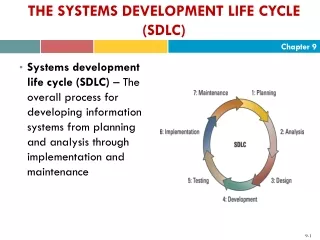
THE SYSTEMS DEVELOPMENT LIFE CYCLE (SDLC) • Systems development life cycle (SDLC) – The overall process for developing information systems from planning and analysis through implementation and maintenance
SOFTWARE DEVELOPMENT METHODOLOGIES • There are a number of different software development methodologies including • Waterfall • Agile • Rapid application development (RAD) • Extreme programming • Rational unified process (RUP) • Scrum
Waterfall Methodology • Waterfall methodology – A sequence of phases in which the output of each phase becomes the input for the next
Agile Methodology • Iterative development – Consists of a series of tiny projects • Agile methodology – Aims for customer satisfaction through early and continuous delivery of useful software components developed by an iterative process using the bare minimum requirements
Rapid Application Development Methodology (RAD) • Rapid application development methodology– Emphasizes extensive user involvement in the rapid and evolutionary construction of working prototypes of a system to accelerate the systems development process • Prototype – A smaller-scale representation or working model of the users’ requirements or a proposed design for an information system • The prototype is an essential part of the analysis phase when using a RAD methodology
Extreme Programming Methodology • Extreme programming (XP) methodology – Breaks a project into tiny phases, and developers cannot continue on to the next phase until the first phase is complete
Rational Unified Process (RUP) Methodology • Rational unified process (RUP) – Provides a framework for breaking down the development of software into four gates • Gate one: inception • Gate two: elaboration • Gate three: construction • Gate four: transition
SCRUM Methodology • Scrum– Uses small teams to produce small pieces of deliverable software using sprints, or 30-day intervals, to achieve an appointed goal • Under this methodology, each day ends or begins with a stand-up meeting to monitor and control the development effort
DEVELOPING SUCCESSFUL SOFTWARE • Primary reasons for project failure • Unclear or missing business requirements • Skipping SDLC phases • Failure to manage project scope • Scope creep • Feature creep • Failure to manage project plan • Changing technology
DEVELOPING SUCCESSFUL SOFTWARE • The later in the SDLC an error is found the more expensive it is to fix!
MANAGING SOFTWARE DEVELOPMENT PROJECTS • Analysts predict investment in MIS projects worldwide is more than $1 trillion • 70 percent will be lost due to failed projects • The consequences of failed projects include • Damaged brand • Lost goodwill • Dissolution of partnerships • Lost investment opportunities • Low morale
MANAGING SOFTWARE DEVELOPMENT PROJECTS • Projectdeliverable – Any measurable, tangible, verifiable outcome, result, or item that is produced to complete a project or part of a project • Project milestone – Represents key dates when a certain group of activities must be performed • Project management office (PMO) – An internal department that oversees all organizational projects
The Triple Constraint Project Management Interdependent Variables
The Triple Constraint • Benjamin Franklin’s timeless advice - by failing to prepare, you prepare to fail - applies to software development projects • The Hackett Group analyzed 2,000 companies and discovered • 3 in 10 major IT projects fail • 21 percent of the companies state that they cannot adjust rapidly to market changes • 1 in 4 validates a business case for IT projects after completion
Project Participants Project Management Role
UNDERSTANDING PROJECT PLANNING • SMART criteria are useful reminders on how to ensure that the project has created understandable and measurable objectives
UNDERSTANDING PROJECT PLANNING • Two primary diagrams used in project planning include PERT and Gantt charts • PERT chart • Dependency • Critical path • Gantt chart
UNDERSTANDING PROJECT PLANNING PERT Chart EXPERT – PERT Chart Example
UNDERSTANDING PROJECT PLANNING MS Project – Gantt Chart Example
MANAGING PROJECTS • Managing a project includes • Identifying requirements • Establishing clear and achievable objectives. • Balancing the competing demands of quality, scope, time, and cost • Adapting the specifications, plans, and approach to the different concerns and expectations of the various stakeholders
OUTSOURCING PROJECTS • In-sourcing (in-house-development) –Uses the professional expertise within an organization to develop and maintain its information technology systems • Outsourcing – An arrangement by which one organization provides a service or services for another organization that chooses not to perform them in-house
OUTSOURCING PROJECTS • Factors driving outsourcing growth include • Core competencies • Financial savings • Rapid growth • The Internet and globalization
OUTSOURCING PROJECTS • Onshore outsourcing • Nearshore outsourcing • Offshore outsourcing
OUTSOURCING PROJECTS • Most organizations outsource their noncore business functions, such as payroll and IT