Download
1 / 74
750 likes | 889 Vues
This document explores the fundamental building blocks for achieving Quality of Service (QoS) expectations over best-effort networks. It examines historical context, the challenges of managing performance without guarantees, and introduces novel closed-loop techniques such as Logical FIFO scheduling and multi-path traffic engineering. The piece also discusses the implications of different service differentiation methods and highlights architectural advantages for edge-based QoS services. Additionally, it addresses the complexities of non-concave user utility functions and offers solutions for graceful service degradation in congested networks.

E N D
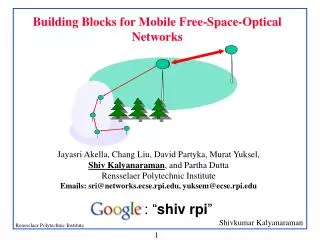
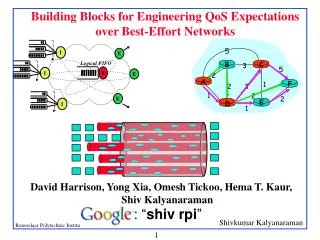
5 I E Logical FIFO 3 5 B I E 2 1 2 3 1 2 E 2 I 1 B F C E A D Building Blocks for Engineering QoS Expectations over Best-Effort Networks David Harrison, Yong Xia, Omesh Tickoo, Hema T. Kaur, Shiv Kalyanaraman : “shiv rpi”
Our Goals… • HISTORY: TCP offers reliability over unreliable networks • Our focus: • Building blocks for … • … performance expectations … • over (I.e. as an overlay) • …multi-domain inter-networks … • ...that do not guarantee performance… • (I.e. best-effort networks)
Expected QoS Using Closed-loop Techniques Part 1: I E 5 Logical FIFO 3 B 5 I E 2 1 2 3 BANANAS Multi-path & TE Framework: incrementally deployable Part 2: 1 E 2 2 I 1 A B E F C D Part 3: E2E Expected QoS Pipe Abstraction: H2H Multimedia Apps Talk Overview [Eg: MSN/Yahoo + Akamai]
Priority/WFQ FIFO B B • Scheduler: differentiates service on a packet-by-packet basis • Loops: differentiate service on an RTT-by-RTT basis using edge-based policy configuration. • Differentiation/Isolation meaningful in steady state only… Part 1: Overlay Closed-loop QoS
Bottleneck queue Edge system End system Architectural Advantages of Closed Loops • Traffic management consolidated at edges (placement of functions in line with E2E principle) • Architectural Potential: • Edge-based (distributed) QoS services, • Edge plays in application-level QoS
Expected Min Rate (EMR) Service: Sample Steady State Behavior Flow 1 with 4 Mbps assured + 3 Mbps best effort Flow 2 with 3 Mbps best effort Issues: Transients, steady state oscillations/tracking errors
QoS can be viewed as a congestion control problem: extension of the idea of fairness and therefore, QoS can be posed in Kelly’s optimization framework Challenges: 1. What about the non-concavity of QoS utility functions? 2. Can we avoid admission control? Graceful degradation instead. Ans: 1. Define & Solve an Auxiliary Optimization Problem 2. Alternative Convex Constraints in Lagrange Domain can avoid need for admission control, allowing graceful service degradation Overlay QoS w/ Closed Loops
weight User s’s send rate User s’s utility function ws can be interpreted as price per unit time or as congestion in the network. Kelly’s Optimization Formulation Network N optimizes Maximize subject to capacity constraints Each user s optimizes Maximize Resulting System optimizes Maximize subject to capacity constraints
Two User Utility Functions Maximize optimum
Issue: QoS => Non-concave User Utility Functions • A single user with a minimum rate QoS expectation (gracefully degrading into a weighted service) can be modeled with a non-concave utility function. • But this kind of U-function cannot be plugged directly into Kelly’s non-linear optimization formulation! log(xs) log(xs-0.4) 10log(xs) expected minimum =0.4
Desired Allocation (oversubscribed) not any of the 2 maxima! • Can use strictly concave functions and define multiple optimization problems for the same QoS problem & • Dynamically choose a different optimization problem when oversubscribed Luckily, the Sum of Non-Concave U-fns is not what we want to Optimize! • U(z) = log(z-0.6)if z > 0.6 (expected minimum rate) 10logz if z <= 0.6 (graceful degradation to weighted svc) Two maxima
No Over-Subscription Case: Auxiliary Problem • Let i.e. flow i: two virtual sub-flows on same path • Think of a modified network with modified link capacities Provide proportional fairness on residual network capacity xie Capacity, C1 Capacity,
Weighted fairness Effective when: ai = Ai • For aip, xip: (auxiliary problem) Exp. Min Rate: Effective when: ai < Ai If under-subscribed, solve the aux-problem; and the primary problem is automatically solved (note: aip = constant) Handling both under- and over-subscription… • For ai, xi: (primary problem)
1 j j+1 J ingress egress dj fi μij Λi,j+1 μi Λi Accumulation: Per-flow Backlog in a Series of Routers • Assuming: • Define accumulation: • which is a time-shifted, distributed sum of buffered bits of flow i at all routers 1 through J • Note: accumulation is an abstract dynamical concept. Vegas and Monaco attempt to provide estimators for accumulation.
1 j j+1 J dj fi μij Λi,j+1 μi Λi … … time 1 j j+1 J 16 Accumulation: Definition & Physical Meaning
1 j j+1 J dj fi μij Λi,j+1 μi Λi Accumulation-based Control Policy • control objective : keep • if goal , no way to probe increase of available b/w; • control algorithm : • Example control algorithm :
1 j j+1 J dj fi μij Λi,j+1 μi Λi out-of-band in-band ctrl pkt Monaco: Robust Accumulation Estimation … … time 1 j j+1 J
out-of-bd ctrl classifier fifo in-band ctrl, data pkt Monaco Accumulation Estimator 1 jf jf+1 Jf djf fi data μij Λi,j+1 μi ctrl Λi Jb jb+1 jb djb 1 ctrl Interior routers provide two priority fifo queues : 1) high priority queue for out-of-band control packet 2) low priority queue for in-band control packet and data packet Can be done w/ IP precedence on existing routers in Internet!!
“Accumulation”: Steering Parameter • Accumulation-based congestion control (ACC) is a nonlinear optimization, where user i maximizes: Ui(xi) = ai lnxi • Accumulation (ai) is the weight (wi) of the weighted prop. fair allocation • Accumulation is hence a “steering” parameter: • Equilibrium accumulation allocation => Equilibrium rate allocation! • Dynamics of CC scheme decoupled from equilibrium spec (unlike AIMD) • Accumulation has a physical meaning: sum of buffered bits of the flow in the path • Accumulation is related to the lagrange multiplier, I.e., ai = pl • For two flows i,k sharing the same path, ai / ak = xi / xk • FIFO queues => arrival order decides departure order => buffer occupancy decides rate allocation q1 q2 x1 x2
Weighted fairness Effective when: ai = Ai • For aip, xip: (auxiliary problem) Exp. Min Rate: Effective when: ai < Ai If under-subscribed, solve the aux-problem; and the primary problem is automatically solved (note: aip = constant) Recall: Handling both under- and over-subscription… • For ai, xi: (primary problem)
Expected Min Rate (EMR) Service Building Block • Accumulation • Control Law di Accumulation limit Target Estimated accumulationin network
Mean Queue Length for EMR No AQM RIO A=30KB A=3000KB AVQ+VD
Service Multiplexing Topology 1,0 ~ 1,3 2,0 ~ 2,3 3,0 ~ 3,3 30M 60K … … … 0,0 0,0 web A web B … … 1ms 35M 75K 0,1 0,1 100M 100M 100M 34ms R0 R1 R2 R3 67ms 50M 60K 0,2 1-100ms 1-100ms 0,2 1-100ms … … 100ms 10M 15K 500 web A users 500 web B users 0,3 0,3 … … … 1,0 ~ 1,3 2,0 ~ 2,3 3,0 ~ 3,3 2,0 has weight 3 • Bandwidth for all unlabelled links are 1Gbps; Delay 1ms; • AQM+VD at router R1, no AQM at other routers
No oversubscription <m00=30,A00=60KB> <m03=10,A03=15KB> Loop 02,03stop sending Web Moderate oversubscription <m01=35,A01=75KB> Gross oversubscription <m02=50,A02=60KB> Service Multiplexing: Expected Min Rate
Queue Lengths Non-AQM: Q-length Q-length w/ virtual accumulation support More details: Y.Xia et al, “Accumulation-based Congestion Control,” to appear in IEEE/ACM Transactions of Networking, early 2005.
Expected QoS Using Closed-loop Techniques [Eg: MSN/Yahoo + Akamai] Part 1: I E 5 Logical FIFO 3 B 5 I E 2 1 2 3 BANANAS Multi-path & TE Framework: incrementally deployable Part 2: 1 E 2 2 I 1 A B E F C D Part 3: E2E Expected QoS Pipe Abstraction: H2H Multimedia Apps Talk Overview
ISP-1 Internet . . . AS1 ISP-n Part 2/3:Best-EffortPath Multiplicity Phone modem USB/802.11a/b 802.11a Firewire/802.11a/b WiFi (802.11b) Ethernet
Multiple E2E Flows Multi-homed interfaces & ISP/AS peers Multi-paths within a routing domain Multi-AS-paths across domains W/o specifying intra-domain paths Multiple exits from an AS w/o specifying intra-domain paths Part 2: Multiplicity: Flows, Paths, Exits/Interfaces BANANAS: A Single Abstract Framework To Exploit These Forms of Multiplicity In the Internet and Future Networks
Isn’t multi-path routing an old subject? • Lots of old work: • Multi-path algorithms/protocols [5, 6, 7, 8]*, • Internet signaling architectures [9, 10, 11, 12, 13]* • Novel overlay routing methods [14, 15]* • Transport-level approaches for multi-homed hosts [16, 17]* • But newer goals: • Traffic engineering (reliability, availability, survivability, re-route): • Separation of traffic trunking from route selection • Packet level or aggregate (micro-flow or macro-flow level) • Best-effort e2e service composition… Why hasn’t it happened after 2 decades of work? *[5-17] In SIGCOMM Future Directions of Network Architectures (FDNA) 2003 paper
Missing Architectural Concepts • An evolutionary partial deployment strategy • Allows partial deployment, incremental upgrades • Incentives: increasing value with increasing deployment • Fits the connectionless nature of dominant routing protocols, • Must not require signaling (unlike ATM, MPLS etc) • Abstract enough to be applicable to other scenarios: • Overlay networks, last-mile multi-hop (mesh or community) wireless networks, ad-hoc/sensor networks… • Flexible enough to have other realizations/semantics: • Different placement of functions (edge vs core) • Tunneling/Label Stacking • Geographic/Trajectory routing
Traffic Engineering (TE) Spectrum … Shortest Path MPLS Signaled TE BANANAS-TE Connectionless TE: Questions • Can we do multi-path & explicit routing ? • without signaling (I.e. in a connectionless context) • without variable (and large) per-packet overhead • being backward compatible with OSPF & BGP • allowing incremental network upgrades • Non-Goals: Monitoring, Traffic trunking/mapping
Seattle New York (Egress) 5 San Francisco (Ingress) 1321 120 Miami IP IP IP IP 0 Label 1321 120 What can we learn from ATM and MPLS ? • MPLS label = Path identifier at each hop • Labels is a local identifier… • Signaling maps global identifiers (addresses, path specifications) to local identifiers
Seattle 5 New York (Egress) 4 4 18 IP 27 3 10 San Francisco (Ingress) 1 9 Miami 5 IP IP IP IP 27 36 0 PathId Global Path Identifiers? • Instead of using local path identifiers (labels in MPLS), consider the use of “global” path identifiers • Constructed out of global variables a node already knows! • Eg: Link/Router IP addrs, Link weights, ASNs, Area Ids, GPS location • Avoid the need for signaling to establish a mapping!
j 2 wm w2 i w1 m-1 1 k Path suffix Global Path Identifier (continued) • Path = {i, w1, 1, w2, 2, …, wk, k, wk+1, … , wm, j} • Sequence of globally known node IDs & Link weights • Global PathID: hash of this sequence: computable w/o signaling! • Canonical method: MD5 hashing of the subsequence of nodeIDs followed by a CRC-32 to get a 32-bit hash value (MD5+CRC) • Low collision (i.e. non-uniqueness) probability • Note: Different PathID encodings have different architectural implications
PathID SuffixPathID H{k, k+1, … , m-1} H{k+1, … , m-1} j 2 wm w2 i w1 m-1 1 k Path suffix Abstract Forwarding Paradigm • Forwarding table (Eg; at Node k): • [Destination Prefix, ] [Next-Hop, ] • [j, ] [k+1, ] • Packet Header: [j, H{k, k+1, … , m-1} ] [j, H{k+1, … , m-1} ]
IP IP IP IP 27 27 27 0 BANANAS TE: Partial Deployment • Only red nodes are upgraded • “Virtual hop” between upgraded nodes • Black nodes compute single-shortest-path Seattle 5 New York (Egress) 4 4 28 IP 27 30 10 San Francisco (Ingress) 1 9 1 X 2 Miami 3 1
Outline • Motivation: Best-effort path multiplicity • BANANAS: Data-plane • BANANAS: Control-plane • BANANAS: Mapping to BGP Not covered: details in SIGCOMM FDNA paper
Multiple E2E Flows Multi-homed interfaces & ISP/AS peers Multi-paths within a routing domain Multi-AS-paths across domains W/o specifying intra-domain paths Multiple exits from an AS w/o specifying intra-domain paths Multiplicity: Take-Home Message… BANANAS: A Single Abstract Framework To Exploit These Forms of Multiplicity In the Internet and Future Networks
Expected QoS Using Closed-loop Techniques [Eg: MSN/Yahoo + Akamai] Part 1: I E 5 Logical FIFO 3 B 5 I E 2 1 2 3 BANANAS Multi-path & TE Framework: incrementally deployable Part 2: 1 E 2 2 I 1 A B E F C D Part 3: E2E Expected QoS Pipe Abstraction: H2H Multimedia Apps Talk Overview
Part 3: Introduction • Motivation: Video over best-effort networks (wired/wireless) • Broadband => more access bandwidth • End-to-end (E2E) => constraints due to path congestion • Virtual extension of broadband access pipe E2E using multi-paths => HOME-to-HOME (H2H) multimedia • Path Diversity: dimensions • Aggregate Capacity • Delay diversity • Loss diversity • Correlations in path performance characteristics • Key: Match inherent content diversity to path diversity
Performance Saturation (even w/ many flows/path) Motivation: Internet Path Congestion limits E2E bandwidth Internet Server Access Link Client Access Link Performance Access Link Speed
Multi-paths using Peers Overlays or peers can provide path diversity even if multi-paths not available natively Issue: diversity of performance (b/w, delay, loss), possible correlations…
Performance Scaling Performance Access Link Speed Smart Multi-path Capacity Aggregation (SMCA): Motivation Path (Flow) Aggregator/ Multiplexer Path (Flow) Aggregator/ De-multiplexer Internet Client Access Link Server Access Link E2E Broadband Virtual Pipe Abstraction!!
High Delay/Jitter Low Capacity Lossy Single path issues: capacity, delay, loss… Time • Network paths usually have: • low e2e capacity, • high latencies and • high/variable loss rates.
Low Perceived Loss High Perceived Capacity Low Perceived Delay/Jitter SMCA: Leverage Diversity!