Download
1 / 28
280 likes | 381 Vues
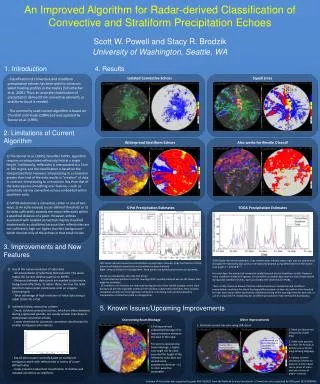
This study presents a new and improved algorithm for the classification of radar-derived precipitation echoes, specifically addressing the limitations of the Steiner et al. (1995) method. By utilizing the native resolution of radar datasets, the algorithm enhances the detection of small, isolated convective echoes that traditional methods often miss. The paper discusses the integration of irregular Cartesian grid techniques to calculate distances between data points and outlines upcoming improvements, including updates to the shallow convection scheme and enhancements for MATLAB users. The research is supported by NSF and DOE grants.

E N D
An Improved Algorithm for Radar-derived Classification of Convective and Stratiform Precipitation Echoes Scott W. Powell and Stacy R. Brodzik University of Washington, Seattle, WA March 4, 2013 MJO Field Data and Science Workshop, Kohala Coast, HI Breakout Session 1A This work was supported by NSF grant AGS-1059611 and DOE grant DE-SC0008452.
Why we need a new/improved algorithm • Steiner et al (1995; SHY95) requires an interpolated dataset. • A standard 2 km interpolation, or even higher resolutions, “creates” data. This is bad. • Small, isolated convective echoes can be completely missed by SHY95.
Fixing the problem • Use the native resolution of the dataset, taking advantage of the high resolution typical along radials. • Easy gridding onto irregular Cartesian grid for determining distance between data points. R (highest spatial resolution) 1. (R,Φ) -> (X,Y) 2. Determine distance between red box and all other data points. Yellow boxes represent those within specified distance. Φ
Fixing the problem • Use the native resolution of the dataset, taking advantage of the high resolution typical along radials. • Easy gridding onto irregular Cartesian grid for determining distance between data points. • Shallow convection scheme
(Soon) Upcoming Improvements • Beam blockage (forAddu radars) - Mask out Addu City completely - Eliminate second-trip echo. - Update shallow convection scheme.
S-Pol Hybrid rain rate TOGA Single Z-R (tentative) Z = 129.56 R1.37
Improved stratiform fraction during suppressed periods
Availability/Suggestions • Only input currently accepted is CFRadial. • Code currently only written for usage with MATLAB. • How to make easy-to-use for most users? • Other suggestions/concerns?