1 / 21

Understanding Sum and Difference Identities in Trigonometry

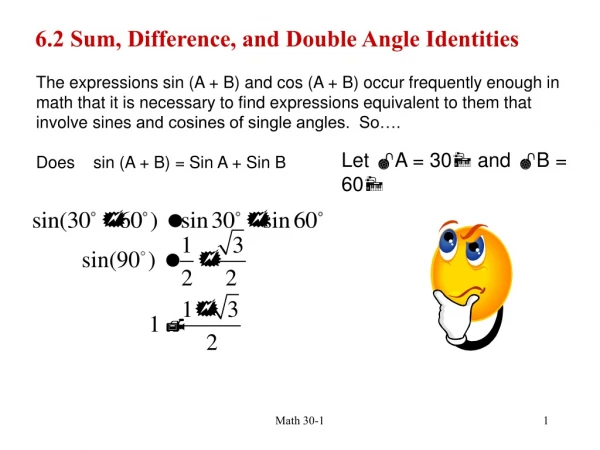
This guide covers the use of sum and difference identities to find exact values of trigonometric ratios for angles that are not special angles (like 0°, 30°, 45°, etc.). It includes step-by-step instructions on finding values such as cos(15°), cos(75°), and cos(120°) using formulas from your reference sheet. Additionally, it explores finding sin(15°) and provides examples for sin(x-y) and cos(x-y) calculations. Make sure you're comfortable with radian notation and have a unit circle handy.

deiter
Télécharger la présentation

Understanding Sum and Difference Identities in Trigonometry

An Image/Link below is provided (as is) to download presentation Download Policy: Content on the Website is provided to you AS IS for your information and personal use and may not be sold / licensed / shared on other websites without getting consent from its author. Content is provided to you AS IS for your information and personal use only. Download presentation by click this link. While downloading, if for some reason you are not able to download a presentation, the publisher may have deleted the file from their server. During download, if you can't get a presentation, the file might be deleted by the publisher.

E N D

Presentation Transcript


  1. M A L7.3 Sum and Difference Identities

  2. Sum and Difference formulas • If you are asked to find the EXACT VALUE of a trigonometric ratio for an angle that is NOT one of the “special angles” on your circle (ie. 0, 30, 45, 60, 90, etc.) you MUST use one of the formulas summarized on page 439-441 and on your formula sheet.

  3. Find cos 15°

  4. You have got to be familiar with radian notation. Make sure you have your unit circle with all radian angle measures written with the common denominator of 12.


  5. Find cos 75°

  6. Find cos 120°

  7. Notice the similarities and differences.

  8. Find sin 15°

  9. Find sin

  10. Find the value of sin(x-y)if x= and y=

  11. Find the value of sin(x-y)if x= and y=

  12. Find the value of cos(x-y)if x= and y=

  13. Notice on your formula sheet how the signs are shown.

  14. Notice on your formula sheet how the signs are shown.

More Related