Download
1 / 1
10 likes | 124 Vues
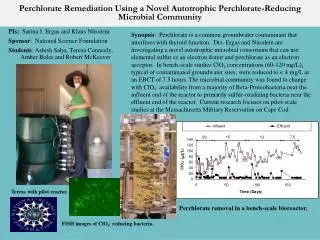
Perchlorate is a prevalent groundwater contaminant that disrupts thyroid function. Researchers Dr. Sarina J. Ergas and Dr. Klaus Nüsslein are exploring a unique autotrophic microbial consortium capable of utilizing elemental sulfur as an electron donor and perchlorate as an electron acceptor. Bench-scale studies demonstrated the successful reduction of ClO4 concentrations (60-120 mg/L) to less than 4 mg/L with an empty bed contact time (EBCT) of 7.5 hours. The microbial community composition shifted based on ClO4 availability, with a transition from Beta-Proteobacteria to sulfur-oxidizing bacteria towards the reactor’s effluent. Ongoing pilot-scale studies are being conducted at the Massachusetts Military Reservation on Cape Cod.

E N D
Perchlorate Remediation Using a Novel Autotrophic Perchlorate-Reducing Microbial Community Synopsis: Perchlorate is a common groundwater contaminant that interferes with thyroid function. Drs. Ergas and Nüsslein are investigating a novel autotrophic microbial consortium that can use elemental sulfur as an electron donor and perchlorate as an electron acceptor. In bench-scale studies ClO4-concentrations (60-120 mg/L), typical of contaminated groundwater sites, were reduced to < 4 mg/L at an EBCT of 7.5 hours. The microbial community was found to change with ClO4- availability from a majority of Beta-Proteobacteria near the influent end of the reactor to primarily sulfur-oxidizing bacteria near the effluent end of the reactor. Current research focuses on pilot-scale studies at the Massachusetts Military Reservation on Cape Cod PIs: Sarina J. Ergas and Klaus Nüsslein Sponsor: National Science Foundation Students: Ashish Sahu, Teresa Conneely, Amber Boles and Robert McKeever Teresa with pilot reactor. Perchlorate removal in a bench-scale bioreactor. FISH images of ClO4- reducing bacteria.