Understanding Derivatives and Sequences: Homework Assistance
This resource covers key concepts in calculus and sequences, including finding derivatives of functions like y = sin(x), as well as identifying and working with Fibonacci, arithmetic, and geometric sequences. Students will find guidance on how to derive the first 15 terms of the Fibonacci sequence, and discover how to formulate terms and derive formulas for arithmetic and geometric sequences. This comprehensive guide facilitates the understanding of fundamental mathematical principles and improves problem-solving skills.

Understanding Derivatives and Sequences: Homework Assistance
E N D
Presentation Transcript
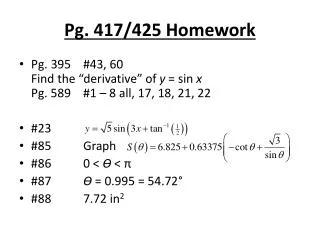
Pg. 417/425 Homework • Pg. 395 #43, 60Find the “derivative” of y = sin xPg. 589 #1 – 8 all, 17, 18, 21, 22 • #23 • #85 Graph • #86 0 < Ɵ < π • #87 Ɵ = 0.995 = 54.72° • #88 7.72 in2
11.1 Sequences Finding Terms in a Sequence Fibonacci Sequence 0, 1, 1, 2, … do you know/see a pattern? an = an – 1 + an – 2 Find the first 15 terms of the Fibonacci Sequence. • List the first three terms and the 15th term of the following sequences:
11.1 Sequences Arithmetic Sequences Examples: The first two terms of an arithmetic sequence are -8 and -2. Find the 10th term and a formula for the nth term. The third and eighth terms of an arithmetic sequence are 13 and 3, respectively. Determine the 1st term and the nth term. • A sequence {an} is called an arithmetic sequence if there is a real number d such that: an = an – 1 + d and an = a1 + (n – 1)dfor every positive integer n. • The number d is called the common difference of the arithmetic sequence.
11.1 Sequences Geometric Sequences Examples: The second and third terms of a geometric sequence are -6 and 12, respectively. Determine the 1st term and the formula for the nth term. • A sequence {an} is called an geometric sequence if there is a nonzero real number r such that: an = r•an – 1 and an = a1 • r n – 1 for every positive integer n. • The number r is called the common ratio of the geometric sequence.