### "Ensuring Safety: Major Accident Prevention and Reporting Requirements" ###
This document outlines the responsibilities of operators under regulations aimed at preventing major accidents and mitigating their impacts on people and the environment. It emphasizes the necessity for comprehensive safety reports that include risk identification, prevention measures, and detailed assessments of potential accidents. The guidelines stress the importance of demonstrating compliance with the ALARP (As Low As Reasonably Practicable) principle, ensuring that risks are managed to an acceptable level. Operators must submit sufficient information to the Competent Authority to fulfill these regulatory requirements. ###

### "Ensuring Safety: Major Accident Prevention and Reporting Requirements" ###
E N D
Presentation Transcript
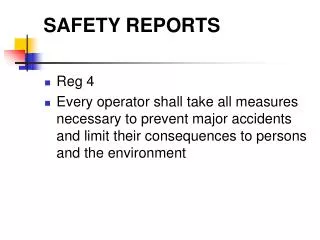
SAFETY REPORTS • Reg 4 • Every operator shall take all measures necessary to prevent major accidents and limit their consequences to persons and the environment
SAFETY REPORTS • Reg 7(7) • The operator shall send to the CA a report containing information which is sufficient for the purposes specified in Part 1 Schedule 4 and comprising at least the information specified in part 2 of that Schedule
Schedule 4-Purpose and Contents of Safety Report • Part1-The purposes referred to in Reg7 are as follows: • 2. Demonstrating that major accidents hazards have been identified and that the necessary measures have been taken to prevent such accidents and to limit their consequencesfor persons and the environment.
Schedule 4 -Part 2Minimum Information to be included in a Safety Report Identification and accidental risk analysis and prevention methods: • detailed description of the possible major accident scenarios • and their probability -----------
Schedule 4 -Part 2Minimum Information to be included in a Safety Report • Identification and accidental risk analysis and prevention methods: • 4(b)assessment of the extent and severity of the consequences of identified major accidents • (R2P2 p76)
ALARP in COMAH • For practical purposes: • All Measures Necessary (AMN)=SFAIRP=ALARP
Existing Guidance • HSE has produced a suite of guidance documents concerning ALARP. These are designed to give high level principles which D/Ds can then use to promulgate sector specific advice. • The documents are: • Reducing Risk, Protecting People (R2P2);
Existing Guidance (continued) • Principles and guidelines to assist HSE in its judgments that duty-holders have reduced risk as low as reasonably practicable; • Assessing compliance with the law in individual cases and the use of good practice; and • ALARP in Design - Policy and Guidance.
'R2P2' 'ALARP Principles and Guidelines' 'Good Practice' D/Ds' Guidance 'Design' Relationship between R2P2 and the ALARP Suite informs* legal commentary + policy informs** HSE's expectation e.g. TOR framework, primacy of Good Practice, tolerability criteria Guidance to Staff Information to Stakeholders HSE's expectation/enforcement policy * Annex 3 of R2P2 reflects the ALARP guidance ** e.g. the concept of 'hypothetical person' set out in R2P2 is adopted in the ALARP guidance
Risk Matrix (Illustrative) Likely >10-2 Intolerable Intolerable Intolerable Intolerable Intolerable TIFALARP(Intolerable if Fatality >10-3) TIFALARP(Intolerable if Fatality >10-3) Unlikely 10-4-10-2 Intolerable Intolerable Intolerable TIFALARP TIFALARP TIFALARP/Intolerable TIFALARP/Intolerable Intolerable Very Unlikely 10-6-10-4 TIFALARP/Broadly Acceptable? TIFALARP TIFALARP Remote 10-6-10-8 Broadly Acceptable Broadly Acceptable Single Fatality 2-10 Fatalities 11-50 Fatalities 50-100 Fatalities 100+ Fatalities
ALARP Demonstration • But the higher the installation lies on the societal concerns scale the greater the need to look for additional measures, over and above the normal standards.How to approach? • 1. Identify risk reduction measures. • 2. Assess using Lines Of Defence analysis with cost estimates • 3. Possibly, in extreme cases, add a Cost Benefit Analysis.