Download
1 / 15
150 likes | 265 Vues
This comprehensive agenda explores the evolution of political theory and practice in ancient Greece, focusing on the transition from Iron Age chiefdoms to the establishment of the Archaic polis. Key topics include the inventions of politics, critical reforms by Draco, Solon, and Cleisthenes, and the structure of early governance systems like the boule and demos. Emphasizing critical thinking, moral integrity, and democratic ideology, the report will highlight influential texts and the philosophical debates surrounding justice and political structures from the period.

E N D
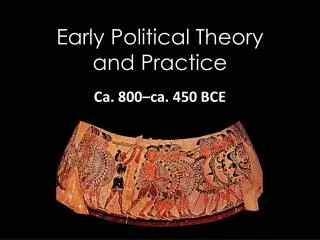
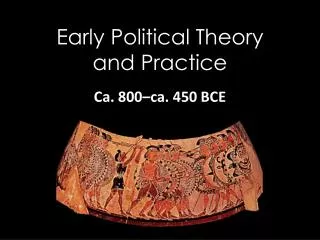
Early Political Theory and Practice Ca. 800–ca. 450 BCE
Agenda • Papers • MLA, Honesty, Critical Thinking • Recap and Update • The Invention of Politics • Oral Report • Natham, Christine, Orin on Monoson on Harmodius & Aristogeiton • Pick a Lens • Dahl, Ober, Scholtz Early Politics
Papers MLA, Honesty, Critical Thinking
Recap and Update The Invention of Politics
Birth of the Polis from Iron-Age chiefdom to Archaic polis synoecism archons boule(aristocratic council) demos(popular assembly) • village networks • basileis • boule(royal council) • demos(rank-and-file) Early Politics
Athenian Timeline • ca. 620 Draco’s law code • thesmoi • 594/3 Solon’s reforms • nomoi • 560-510 Peisistratean tyranny • 507 Cleisthenic reforms Early Politics
Critical Thinking: Solon (594/3? BCE) • Birth qualification => property qualification. • Cancellation of debt. • End to debt-slavery. • Council (boule) of 400. • Citizen-jury courts (eliaia, dikasteria). Tyranny? Oligarchy? Democracy? Early Politics
Cleisthenic Reforms (507 BCE) from oligarchy clan/village constituencies 4 tribes archons Council of 400 to proto-democracy deme-trittys organization 10 tribes archons + stratēgoi Council of 500 isonomia
Readings: Issues • Justice and the state • Stasis, eunomia • monarkhia, isonomia • Constitutional concerns • democracy • oligarchy • tyranny • Questions of peitho Early Politics
Oral Report Natham, Christina, Orin
Pick a Lens Dahl, Ober, Scholtz
Dahl’s Criteria • Effective participation. • Voting equality at the decisive stage. • Enlightened understanding. • Control of agenda. “Strong principle of equality” (compare isonomia) Early Politics
Ober’s Dialectic • Mass “hegemony” / elite “advice” • Political equality / material inequality • Freedom / consensus Ideological-rhetorical negotiation Early Politics
Pick a Lens. . . • Aeschylus Suppliant Women • “… I shall go to advance your cause. May Persuasion and Fortune Who Brings Success attend me” • Eupolis Demes • “A certain peitho resided on [Pericles’] lips, …! And he alone of the orators left a sting in his listeners” • Protagoras in Plato’s Protagoras • [Hermes:] “ ‘Shall this be the manner in which I am to distribute justice and reverence among human beings, or shall I give them to all?’ ‘To all,’ said Zeus” Dahl? Ober? Scholtz? Early Politics