
Advanced Molecular Dynamics Simulations of Stress Corrosion Cracking Mechanisms in Materials
This research explores the atomistic mechanisms of stress corrosion cracking through advanced molecular dynamics simulations. The study reveals how frictional sliding of pre-crack surfaces in confined silica glass leads to the nucleation of nanovoids and the growth of wing cracks under dynamic compression. The collaboration includes experts from USC, Caltech, Purdue, and Texas A&M, focusing on predictive potentials and scalable simulation algorithms. Additionally, a workshop for underrepresented groups provided hands-on experience in parallel computing for 24 undergraduates and 12 faculty mentors.

Advanced Molecular Dynamics Simulations of Stress Corrosion Cracking Mechanisms in Materials
E N D
Presentation Transcript
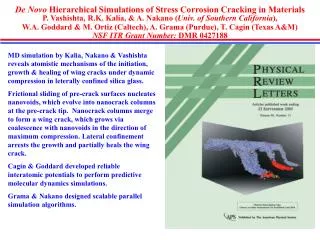
De Novo Hierarchical Simulations of Stress Corrosion Cracking in MaterialsP. Vashishta, R.K. Kalia, & A. Nakano (Univ. of Southern California), W.A. Goddard & M. Ortiz (Caltech), A. Grama (Purdue), T. Cagin (Texas A&M)NSF ITR Grant Number: DMR 0427188 MD simulation by Kalia, Nakano & Vashishta reveals atomistic mechanisms of the initiation, growth & healing of wing cracks under dynamic compression in leterally confined silica glass. Frictional sliding of pre-crack surfaces nucleates nanovoids, which evolve into nanocrack columns at the pre-crack tip. Nanocrack columns merge to form a wing crack, which grows via coalescence with nanovoids in the direction of maximum compression. Lateral confinement arrests the growth and partially heals the wing crack. Cagin & Goddard developed reliable interatomic potentials to perform predictive molecular dynamics simulations. Grama & Nakano designed scalable parallel simulation algorithms.
De Novo Hierarchical Simulations of Stress Corrosion Cracking in MaterialsP. Vashishta, R.K. Kalia, & A. Nakano (Univ. of Southern California), W.A. Goddard & M. Ortiz (Caltech), A. Grama (Purdue), T. Cagin (Texas A&M)NSF ITR Grant Number: DMR 0427188 Kinetic Monte Carlo simulation of hydrogen diffusion near a dislocation loop in iron shows the segregation of H atoms in the core region of both edge & screw dislocations, which play an important role in hydrogen embrittlement. To reach macroscopic length & time scales in the study of environmentally assisted cracking, Ortiz is developing a scheme to couple molecular dynamics interatomic potentials, discrete dislocation framework, & kinetic Monte Carlo methods. Effect of the stress field of a dislocation loop in Fe on the energies of Hydrogen interstitial sites and redistribution of H.
De Novo Hierarchical Simulations of Stress Corrosion Cracking in MaterialsP. Vashishta, R.K. Kalia, & A. Nakano (Univ. of Southern California), W.A. Goddard & M. Ortiz (Caltech), A. Grama (Purdue), T. Cagin (Texas A&M)NSF ITR Grant Number: DMR 0427188 The USC-Caltech-Purdue-TA&M team co-organized the 5th Computational Science Workshop for Underrepresented Groups, which provided 24 undergraduates & 12 faculty mentors from 20 HBCUs & MSIs with hands-on experience in parallel computing, including the assembly of PC nodes from off-the-shelf components, loading them with scientific & simulation software, and connecting them to a Gigabit switch. This parallel computer was used for algorithmic & simulation exercises in a tutorial setting.