Download
1 / 8
80 likes | 187 Vues
Dive into the cutting-edge research conducted at the University of Mississippi focusing on black holes, compact binaries, and their astrophysical implications. Highlighting formidable work since 2009, our studies encompass black hole perturbation theory, numerical relativity, and quantum scattering, contributing over 30 research papers to the field. Key topics include astrophysical tests of strong-field gravity, gauge-gravity duality, and the dynamics of black hole collisions. Our collaborations and significant grants support ongoing exploration into the mysteries of the universe.

E N D
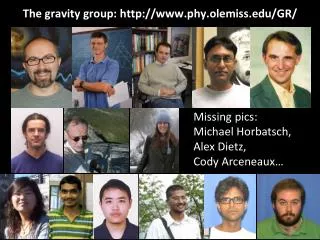
The gravitygroup: http://www.phy.olemiss.edu/GR/ Missing pics:Michael Horbatsch,Alex Dietz, Cody Arceneaux…
Black holes and compact binaries: astrophysics and high-energy physicshttp://www.phy.olemiss.edu/~berti/ EmanueleBerti, University of Mississippi/Caltech University of Mississippi, 9/7/2010
Work at Ole Miss (since Jan 2009): 30+ papers • 1) Black holeperturbationtheory and quasinormalmodes • Mainapplications: • a) Astrophysics (tests of the no-hairtheorem) • b) Gauge-gravityduality • 110-page review (arXiv:0905.2975, with Cardoso & Starinets) • Critical phenomena: Lyapunovexponents • Quantum mechanicalscattering: Breit-Wignerresonances • Green’sfunctionstechniques: quasinormal mode excitation • 2)Numericalrelativity and relativisticblackholecollisions • Head-on collisions (E<14%, no nakedsingularities; PRL) • Grazing collisions (E<35%, spin >0.95; PRL) • AstrophysicalrotatingBHs are notparticleaccelerators (PRL) • Semianalyticstudy: zero-frequencylimit, pointparticles • Superkicks for ultrarelativisticcollisions
Work at Ole Miss (since Jan 2009): 30+ papers • 3) Black holeastrophysics • Spin-orbitresonances: implications for recoildistribution • Compact binaryrates for advanced detectors – workshop! • eLISA Science Taskforce • Massive blackholecosmichistory • Eccentricbinaries • 4) Astrophysicaltests of strong-fieldgravity • Stars in extendedgravitytheories, spontaneousscalarization • Gravastars and superspinars • Graviton mass bounds with compact binaries • Massive scalar fields: a) Tests in the Solar System/with gravitationalwavesb) Superradiance and floatingorbits (PRL) • c) Bosenovas and limits on the photon mass
Support: • As PI or Co-PI: • NSF Grant PHY-0900735 ($150k, 2009-2012) NSF CAREER Grant PHY-1055103 ($460k, 2011-2016)NSF Grant PHY-090003 (2009-2012, 6.5million CPU hours) • with U.Sperhake (Cambridge), V.Cardoso (Lisbon), F.Pretorius (Princeton) • European Union FP7 IRSES (318k euros, 2012-2016) • ”International Research Staff Exchange Scheme”; E.Berti (UM), V.Cardoso(Lisbon), L.Crispino (Belém), L.Gualtieri (Rome), C.Herdeiro (Aveiro), U.Sperhake (Cambridge) • Pending: • GAANN proposal to fund 4/5 graduate studentseveryyear • As collaborator: • SFB Project on Advanced LIGO/Virgo Rates (10k euros, 2012) • CERN/FP/123593/2011 FCT PTDC/FIS/098025/2008 • FCT PTDC/CTE-AST/098032/2008
StartingSeptember 2012: Michael Horbatsch (postdoc), Davide Gerosa (Master student in Milan)