Download
1 / 8
80 likes | 193 Vues
This analysis explores the complexities of establishing democracy in Pakistan following the era of Benazir Bhutto. With a history rooted in theocratic versus secular tensions, Pakistan faces significant obstacles, including military dominance, educational deficiencies, and entrenched feudal politics. We examine the potential for pluralism within Islamic societies and assess the implications of past political dynamics, particularly with regard to the Taliban. The discussion also includes recommendations for U.S. policy aimed at building a more stable and democratic Pakistan.

E N D
Pakistan after Benazir:Promise and Peril towards an Islamic DemocracyDr. Saleem H. Ali Saleem.Ali@uvm.edu http://www.uvm.edu/~shali
Historical context • One of only two modern countries formed solely on the basis of religion • Former British India was divided into India and Pakistan in 1947 (including what is now Bangladesh) • Civil war in 1971 led to the formation of the independent state of Bangladesh • The essential tension between a theocratic versus secular state has existed since inception
Three Limitations to Pakistan’s democratization • The army’s dominance in every aspect of political and economic life • Refer to new book By A. Siddiqua Military Inc. • A lack of education leads to asymmetric and inefficient outcomes • People are much more easily taken in by propaganda and conspiracy theories • Feudal elite still control the political scene • Benazir was part of this establishment
Islam and Democracy • Considerable debate about the prospect of democracy in Islam given a history of non-electoral politics • Clearly not dynastic in its early history but tensions existed on this too – Shia versus Sunni split on dynastic succession • Meritocracy and consensus (shuraa) were the main deliberative mechanism rather than pure voting output
Islam and Pluralism • Diversity is accommodated within a fairly regimented system in traditional doctrines • However, Islamic societies have shown the ability to adapt much more than they are given credit for these days (as far back as Moorish times or Emperor Akbar’s reign in India: Maria Rosa Menocal’s work) • In contemporary societies Malaysia, the UAE and the gulf states are often presented as examples of pluralism (without democracy)
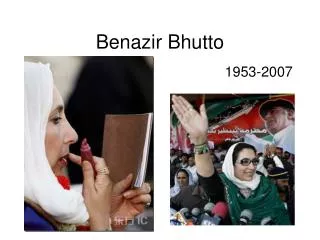
Can Pakistan follow a path in this regard after Benazir? • Benazir initially had placated a lot of the traditional Islamist elements: she recognized the Taliban government and was willing to meet Mullah Umar in the early nineties • More recently her views had moved towards confrontation with the Islamists • The moderate majority in Pakistan is increasingly afraid of the armed militants • External intervention is still anathema to most Pakistanis regardless of political persuasion
Suggestions for U.S Policy • Focus on populist appeal rather than personality-driven politics: there’s more to Pakistan than Musharraf and Bhutto • Support a major arms buy-back / exchange for development effort that leads to more robust economies in NWFP and Southern Punjab • Public diplomacy efforts should continue as they have been started since 9/11 – example the 200+ Fulbright program and the work of World Affairs Councils