The Rise of Big Business and the Gilded Age: Rockefeller and Carnegie's Strategies
110 likes | 230 Vues
This analysis explores the rise of big business during the Gilded Age, focusing on how industrial titans like John D. Rockefeller and Andrew Carnegie established monopolies in their respective industries. It examines the political cartoon from December 12, 1913, illustrating their influence over government and society. The methods they employed to dominate markets, from creating trusts to controlling production, are discussed. This period revealed stark economic disparities, with immense wealth masking underlying societal issues, emphasizing the era's complexities.


The Rise of Big Business and the Gilded Age: Rockefeller and Carnegie's Strategies
E N D
Presentation Transcript
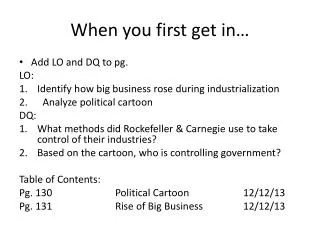
When you first get in… • Add LO and DQ to pg. LO: • Identify how big business rose during industrialization 2. Analyze political cartoon DQ: • What methods did Rockefeller & Carnegie use to take control of their industries? • Based on the cartoon, who is controlling government? Table of Contents: Pg. 130 Political Cartoon 12/12/13 Pg. 131 Rise of Big Business 12/12/13
Robberbaron • Businessman who became wealthy through dishonest methods
The Gilded Age • Wealth of a few masked the real problems • Corrupt politics • 1890: average income for 11 million of 12 million families in was $380, below poverty line • Authors name industrialization “Gilded Age” • gild= cover in gold leaf • Gold disguises an object of lesser value
Corporation How did it help businesses grow? What is it?
John D. Rockefeller • Put competitors out of business by creating monopoly on the oil industry • Got other oil companies to form one BIG one: Standard Oil Trust • The trust controlled 95% of the oil industry • Once in control, Rockefeller raised the price of oil • With no one else to buy oil from, people had no choice but to pay Standard Oil’s high prices
John D. Rockefeller • Throughout his life he donated over $500 million to universities and charities
Andrew Carnegie • Andrew Carnegie tried to beat his competition by creating a better, cheaper product • Carnegie sought to control all the processes that led to the manufacture of steel • He bought iron mines and ships and railroads that carried the iron ore to his mills • Throughout his life he donated over $350 million to universities and charities • sold to JP Morgan, the nation’s top banker, for $480 million