Understanding Matter: Mass, Elements, Compounds, and Bonds
340 likes | 446 Vues
Explore the fundamental concepts of matter, including the differences between mass and weight, the structure of atoms, and the nature of elements and compounds. Learn about atomic and mass numbers, isotopes, and the importance of carbon in organic chemistry. Delve into the differences between covalent and ionic bonds, the states of matter, and the role of activation energy in reactions. Understand the unique properties of water, including polarity and hydrogen bonding, which contribute to its importance in biological systems.


Understanding Matter: Mass, Elements, Compounds, and Bonds
E N D
Presentation Transcript
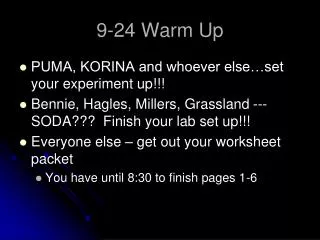
9-24 Warm Up PUMA, KORINA and whoever else…set your experiment up!!! Bennie, Hagles, Millers, Grassland --- SODA??? Finish your lab set up!!! Everyone else – get out your worksheet packet You have until 8:30 to finish pages 1-6
Terms… • Matter – • Anything that occupies space and has mass • What is the difference between mass and weight? • Mass – • Amount of matter something has • What is weight? • Measure of the pull of gravity on an object
Elements • Substances that cannot be broken into simpler kinds of matter • Atom – • Simplest particle of an element that retains the properties of that element • Nucleus - • Contains protons and neutron • Makes up most of the mass
Proton • Positively charged particles in nucleus • Electron • Negatively charged particles that orbit the nucleus • Neutron • Neutral particle in the nucleus
Atomic Number • Number of protons • Mass Number • Number of protons and neutrons in an atom • Isotopes • Atoms can have different number of neutrons • EX: Carbon-12, Carbon-13 & Carbon-14 • So the number of isotopes are averaged and that is the mass number on the periodic table • So the majority of Carbon (~99%) has ______ neutrons? • 6
9-25 Warm up • What is the difference between atomic number and mass number? • Water your plants (not too much!) Water is in water bottles up front. • Get out the worksheet pages 1-6…put your name on it…tear off back sheet…pass pages forward!!! • Also, hand in your warm ups!
Compounds - • Atoms of two or more elements • Elements usually bond to become more stable • Energy Levels • First energy level can hold 2 electrons • Second energy level can hold 8 electrons • Third energy level can hold 18 electrons • Atoms want their energy levels to be full so they are more stable • http://my.hrw.com/sh/hm2/0030724872/student/ch02/sec01/qc07/hm202_01_q07fs.htm • Draw this….
How many electrons in… • How many does it need to become stable? • How many electrons in… • And how many needed to be stable?
9-28 Warm Up • How many electrons can carbon accept in it’s 2nd energy orbital? • Check your plants for growth and water them if the soil is no longer moist.
Carbon = Organic Chem. • Carbon bonds readily with other elements…why do you think this happens? • B/c carbon has only4 e- in it’s outer orbital,meaning it readily accepts e- from otherelements
Compound • Aspirin: • http://my.hrw.com/sh/hm2/0030724872/student/ch02/sec01/qc08/hm202_01_q08fs.htm
Sharing 1 electron = single bond Sharing 2 electrons= double bond Sharing 3 electrons= triple bond • Draw…
Bonds • Covalent Bond – • Two atoms share electrons • Water • http://my.hrw.com/sh/hm2/0030724872/student/ch02/sec01/qc09/hm202_01_q09fs.htm
Bonds • Ions – • Atom / molecule with a charge ( + or - ) • Elements give / take electrons to become more stable • Ionic Bond – • Charged ions attracting each other • http://my.hrw.com/sh/hm2/0030724872/student/ch02/sec01/qc12/hm202_01_q12fs.htm
9-29 Warm Up • What is the difference between a covalent bond and an ionic bond?
States of Matter • Solid • Liquid • Gas • Which state has the least energy? The most? • Solid Liquid Gas • Which state occupies the most volume? • Which take shape of container?
Activation Energy • Activation Energy – • Most rxns need energy input to begin • Enzyme - • Protein that speeds up rxns w/o being changed (lowers activation energy) • http://my.hrw.com/sh/hm2/0030724872/student/ch02/sec02/qc06/hm202_02_q06fs.htm
Polarity • Polarity – • When a molecule has an uneven distribution of charge • Water - • Oxygen doesn’t share the e- equally with hydrogen • The oxygen pulls the e- closer, thus the oxygen has a partial negative charge and the hydrogen gets a partial positive charge (draw the picture)
Bonds • Hydrogen Bonds – muyimportante • Weak attraction between the partially negative oxygen and partially positive hydrogen • This is gives water some VERY IMPORTANT qualities
Hydrogen bonds creates surface tension – water “sticks” to itself • Which is more dense, water or metal? • Metal • Floating paper clip?!?! • Metal, but paperclip floats b/c water is weakly bonded and those bonds are not breaking.
States of Water • What is the most dense state of water? • Water • This is very important…b/c if ice was more dense lakes wouldfreeze solid and no life could survive
9-30 Warm Up • What is activation energy? • Test and review sheets due Monday…review for the test tomorrow
Solubility • How well something will dissolve in a liquid • Water = polar….which allows it to dissolve other polar / ionic substances • Or substances that ionically bonded • NaCL • http://www.youtube.com/watch?v=gN9euz9jzwc&feature=related
Water and Oil • Do water and oil mix? Why / why not? • Below is the chemical structure of olive oil…it is NON-POLAR • The POLAR water does not dissolve / interact with the NON-POLAR oil.
In your notes…using a book • Define: • Cohesion – • attractive force of similar substances • Water to water • Adhesion – • Attractive force of different substances • Water to glass • Explain how capillary action or capillarity works
pH – • Measure of how acid / basic a substance is
Acids and Bases • Acids http://my.hrw.com/sh/hm2/0030724872/student/ch02/sec03/qc05/hm202_03_q05fs.htm • Have low pH • Have a lot of H3O+ (HCL or H2SO4) • H20 + HCl = H30+ + Cl- • http://my.hrw.com/sh/hm2/0030724872/student/ch02/sec03/qc06/hm202_03_q06fs.htm • Bases • High pH • Have a lot of OH- (NaOH) • H20 + NaOH = Na+ + OH- • http://my.hrw.com/sh/hm2/0030724872/student/ch02/sec03/qc07/hm202_03_q07fs.htm