osteoarthritis
450 likes | 474 Vues
Explore the classification, systemic risk factors, intrinsic vulnerabilities, loading factors, and pathogenesis of osteoarthritis. Learn about clinical features, diagnostics, and advanced imaging methods for accurate diagnosis and management.


osteoarthritis
E N D
Presentation Transcript
osteoarthritis Esmaeili ~ Esquivel ~ Fernandez ~Ferrandiz ~ Flores ~ Francisco ~ Gansatao ~ Gatmaitan ~ Golpeo ~ Gutierrez
Approach to musculoskeletal complaint Articular or Non-Articular? < or > 6 Weeks? Inflammatory or Not? Which joints?
Articular vs non-articular Non-Articular Structures • Extra-articular ligaments • Tendons • Bursae • Muscle • Fascia • Bone • Nerve • Overlying skin Articular Structures • Synovium • Synovial Fluid • Articular cartilage • Intraarticular ligaments • Joint capsule • Juxtaarticular bone
Articular vs non-articular Features of Non-Articular • Point or focal tenderness • Painful of active ROM • Seldom demonstrate swelling, crepitation, instability or deformity Features of Articular • Deep or diffuse Pain • Pain or Limited ROM on active and passive movement • Swelling • Crepitation • Instability • “Locking” • Deformity
Approach to musculoskeletal complaint Articular or Non-Articular? < or > 6 Weeks? Inflammatory or Not? Which joints?
Inflammatory vs non-inflammatory • Cardinal signs of inflammation • Systemic symptoms • Laboratory evidence • Prolonged morning stiffness
Approach to musculoskeletal complaint Articular or Non-Articular? < or > 6 Weeks? Inflammatory or Not? Which joints?
OSTEOARTHRITIS Hip, DIP, PIP Articular Chronic Non-inflammatory
Osteoarthritis • Represents failure of the diarthrodial joint. • The most common joint disease in humans • Joint failure due to impaired joint protective mechanisms
Joint Failure • Joint failure occurs in the setting of loss of protective mechanisms • Joint protectors include: • Joint capsule and ligaments, synovial fluid • Muscle • Sensory afferents • Bone
Classification • Idiopathic • Localized • Hands • Feet • Knee • Hip • Spine • Other single sites, e.g., glenohumoral, acromioclavicular, tibiotalar, sacroiliac, temporomandibular • Generalized includes 3 or more of the area listed above
Classification • Secondary • Trauma • Congenital or developmental • Metabolic • Endocrine • Calcium deposition diseases • Neuropathic • Endemic • Miscellaneous • Frosbite • Caisson’s disease • hmoglobinopathies
I. Systemic Risk Factors • Age – most powerful risk factor. 2% prevalence among women <45years, 30% among 45-64 years and 68% among >65 years. • Cartilage are less responsive to stimulus for synthesis of matrix. Muscles and joints are less responsive to incoming loading movement. • Sensory nerve impulses are also slowed down with age thus halting the feedback mechanism of mechanoreceptor
Sex – more common in older women, possibly due to loss of estrogen during menopause. • Hip OA more common in male • Interphalangeal and thumb base OA more in women • Genetics – a woman with mother and sister affected with interphalangeal OA is 2-3x at risk • Race – Hip OA is less common in Chinese than Caucasians. OA more in Native Americans than in Caucasians.
II. Intrinsic Joint Vulnerabilities • Congenital hip diseases such as Legg-Perthes disease increase focal stress to hip joints increasing susceptibility to OA later in life. • Knee anomalies and malalignment such as Varus and Valgus deformity.
III. Loading Factors • Obesity – most potent risk factor for hip and knee OA. There is a linear relationship between risk of OA and increase in weight. 5kg weight loss is associated with 50% risk reduction. • Repetitive joint use – among miners, farmers, and runners.
Pathogenesis • The biomaterial properties of the articular cartilage and subchondral bone are normal, but excessive loading of the joint causes the tissues to fail. • The applied load is reasonable but the material properties of the cartilage or bone are inferior. • Decrease in polypeptide mediators which regulates biosynthesis of PGs responsible for compressive stiffness of tissue and withstand load. • Increase in IL-1 leading to suppression of PG synthesis and inhibiting matrix repair.
Pathogenesis • Hyaline cartilage loss. • Chrodrocytes attempts repair. Also stimulating inflammatory cytokine • Cartilage break down, bone exposure and development of subchondral cyst • Subchondral plate sclerosis, osteophyte growth and sinovitis. • Weakness of muscle bridging
Clinical features • Joint stiffness / morning stiffness (<30 mins) • Joint pain (activity-related) • Episodic • Trigerred often by a day or two of overactive use of a diseased joint • Nocturnal pain • Mechanical symptoms: buckling, catching, or locking. • Limitation of joint movement • Deformity
Laboratory tests • No blood tests are routinely indicated • Examination of the synovial fluid is to rule out other causes of the pain and swelling.
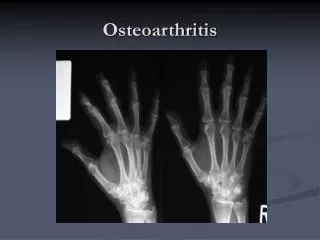
Imaging methods X-ray • Joint Space Narrowing • Development of Osteophytes • Subchondral Sclerosis • Subchondral Cyst Formation • Subluxation
Treatment goals • Pain reduction • Maintenance of mobility • Minimization of disability NICE Clinical Guideline 59
Pharmacologic treatment • Paracetamol first line drug for mild pain; max dose of 4g/day; close monitoring of upper GI adverse events • Tramadol control of moderate pain and improvement in knee function • Oral NSAIDs and COXIBs small to moderate effect in reducing exacerbations of knee OA; up to 2 weeks duration • Topical NSAIDs control of symptomatic or acute exacerbation of knee OA and improvement of function (PRA Practice Guidelines)
Pharmacologic treatment • Intraarticular Steroids effective and safe for moderate symptomatic exacerbations of knee OA; with effects up to 1-3 weeks (PRA Practice Guidelines) • Rubefacients / Capsaicin for reduction of joint pain and tenderness • Intraarticular Hyaluronic Acid for moderate pain and improvement in function; 3-5 weekly injections; longer duration of action than steroids (PRA Practice Guidelines)
Non-pharmacologic treatment Reduction of Joint Loading • Rest but not complete immobilization • Except in hand OA: DIP joint OA > custom-made splint to block flexion, improve overall hand function and reduce muscle spasm • Splinting Effective for trapeziometacarpal joint and pantrapezialOA
Non-pharmacologic treatment Patient Education • Provide additive benefit 20 to 30% as great as that of NSAID alone • Taking medications properly and communicating with health care providers • Decreases pain, disability and depression
Heat reduces pain and stiffness Hot shower or bath • Better analgesia with ice than heat • Wedged insoles / orthoses (polypropylene mesh insole = inexpensive and practical) - useful in OA of the medial tibialcompartment • Reduction of joint contact forces Unilateral OA cane should be held on contralateral side Bilateral Disease crutches or walker
Disuse of OA joint will lead to muscle atrophy • Periarticular muscles protects articular cartilage from stress hence strengthening exercises are important • Studies showed decreased pain, anxiety and depression with exercise • Weight loss for obese patients reduces joint loading 5% weight reduction significantly improves pain and function (PRA Practice Guidelines)
PATELLAR TAPING • Patellofemoral compartment severe pain Taping of patella reduces pain with isometric exercise to strengthen vastusmedialisobliquus component of quadriceps realignment of patella on a long term basis
ORTHOPEDIC SURGERY • Tidal irrigation of the knee • Arthroscopic debridement and lavage • Joint replacement for advanced OA • Joint arthroplasty may relieve pain and increase mobility • Osteotomy can eliminate concentration of peak dynamic loads and provides pain relief • Cartilage regeneration
references • Fauci, A.S et al (2008) Harrison’s Principles of Internal Medicine (17thed) NY: McGraw Hill Co, Inc. • National Institute for Health and Clinical Excellence (2008) “Osteoarthritis: The care and management of osteoarthritis is adults.” NICE Clinical Guideline 59. London: NHS. • Philippine Rheumatology Association (n.d.) “PRA Clinical Practice Guidelines for the Medical Management of Knee Osteoarthritis” Retrieved from http://philippinerheumatology.org/cgi-bin/news/news_details_print.asp?news_id=56 [07Aug 2011].