Single Tooth vs. Full Arch Implants Understanding Your Options
0 likes | 2 Vues
This guide breaks down how each option works, who itu2019s best for, and what recovery and upkeep look like. If you are considering dental implants in Garland, TX, start here.<br>


Single Tooth vs. Full Arch Implants Understanding Your Options
E N D
Presentation Transcript
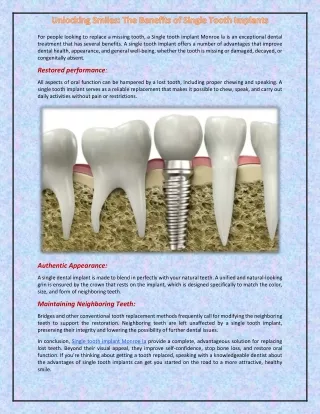
Single Tooth vs. Full Arch Implants: Understanding Your Options February 1, 2026 Dental implants are small posts placed in the jaw to support replacement teeth. They can restore a single space or an entire arch, depending on your goals and bone health. This guide breaks down how each option works, who it’s best for, and what recovery and upkeep look like. If you are considering dental implants in Garland, TX, start here. Overview of Dental Implant Solutions A dental implant takes the place of the lost root and bonds to the jawbone, providing a solid foundation for replacement teeth. They support a crown (one tooth), a bridge (several teeth), or a full arch prosthesis. Why do many patients choose implants? ● Help preserve the jawbone where teeth are missing. ● Do not rely on adjacent teeth for support. ● Feel secure when chewing and speaking. ● It can be designed to look natural and balanced. What Single Tooth Implants Involve A single implant fills one gap and leaves the neighboring teeth untouched.
When it helps ● One isolated gap from decay, fracture, or a failed restoration. ● Healthy gums and adequate bone in that site. ● Desire to avoid shaping adjacent teeth for a bridge Typical steps ● Site evaluation and imaging. ● Implant placement and healing. ● Abutment and custom crown. What Full Arch Implants Involve Full arch treatment rebuilds an entire row of teeth on several implants that serve as anchors. Who it’s for ● Many non-restorable or missing teeth. ● Loose or failing dentures and repeated breakage. ● Need for improved chewing strength and smile support. Prosthesis styles ● Fixed bridge (screw-retained) that stays in place. ● Removable implant-retained option for easier cleaning. Comparison Snapshot ● Best Use: Single tooth = one or a few spaces; Full arch = widespread tooth loss. ● Implant Count: Single tooth = 1 per site; Full arch = usually 4–6 per arch.
● Restoration: Single tooth = crown; Full arch = fixed bridge or removable hybrid. ● Tooth Prep: Single tooth = none for neighbors; Full arch = comprehensive planning. Ideal Candidates for Each Option Single tooth candidates usually have healthy gums, adequate bone in the space, and good home care. Full arch candidates often present with multiple failing teeth, a history of gum disease now controlled, or dentures that shift during meals. Your medical history, medications, and bone quality are reviewed by our dentist, Dr. Nazanin Abolhasani to confirm safety and timing. Cost, Procedure, and Recovery Differences Costs vary with imaging, number of implants, grafting needs, and the final teeth chosen. A single site is less overall; for many failing teeth, a full arch can be more cost-efficient per tooth replaced. Typical timelines ● Single tooth: placement → 3–4 months of healing → abutment and crown ● Full arch: extractions (if needed) → multiple implants → provisional teeth → final bridge after integration Recovery notes ● Swelling and soreness for several days are common. ● Soft diet initially; full arch cases often need a longer soft-food period. ● Follow-ups adjust bite and confirm tissue health.
Aesthetic and Functional Outcomes A single implant crown is color-matched and shaped to blend with surrounding teeth. Full arch restorations re-establish the smile line, tooth proportions, and facial support. Patients often notice clearer speech and improved chewing. A dentist in Garland, TX, will design the result to balance looks, bite forces, and gum health. Long-Term Maintenance and Durability Implants can last many years with consistent care. Daily care checklist ● Brush twice daily; clean under the prosthesis with floss or interdental aids. ● Use a non-abrasive toothpaste and follow your hygienist’s tool recommendations. ● Nightguard use is recommended for patients who clench or grind. ● Keep routine exams to monitor bone and implant components. If you are comparing options, a dentist near you might explain that long-term success depends on daily hygiene and showing up for maintenance visits. When to See a Dentist ● A missing tooth affects chewing or confidence. ● Dentures feel loose, rub, or break frequently. ● Teeth are failing in multiple areas. ● You want a fixed option that protects the bone and stabilizes your bite.
Final Thoughts Choosing between a single implant and a full arch solution depends on how many teeth need replacement, bone levels, timeline, and budget. A complete exam, imaging, and a clear plan help you move forward with confidence. For guidance from consultation through follow-up, the team at Magnolia Dentistry – Garland can tailor an implant approach that fits your goals.