Understanding Faults: Types, Mechanics, and Homework Assignments
This document discusses various types of geological faults, including strike-slip, normal, and thrust faults. It details their characteristics such as displacement and rock layering, providing examples of how younger rocks can be found on top of older ones in different fault types. The text also emphasizes the mechanics behind faults, like tensile loading and the effects of shear fractures. Additionally, it includes homework assignments related to these concepts and important field trip information to Cottonwood Canyon.

Understanding Faults: Types, Mechanics, and Homework Assignments
E N D
Presentation Transcript
Faults • Homework due today - • New homework assignment handout today
Joints: Geometry: planar; plumose structure; joint “sets” Kinematics: walls move apart very slightly in direction of “pull” Mechanics: form by tensile loading; cooling; *removal of overlying rock Other: abundant in uppermost crust
Under compression, rocks fail along shear fractures (sliding motion rather than pulling apart motion) Introduction to Faults (p. 269-279; 286-296)
Fault: Shear fractures along which there is visible offset; generally planar or curviplanar
Strike-slip faults: Accommodate horizontal slip between adjacent blocks; steep (~vertical) faults left lateral (sinistral) right lateral (dextral) left lateral vs. right lateral: sense-of-slip relative to a chosen block
For faults that are not vertical…. Hanging wall: The block above the fault. Footwall: The block below the fault.
Normal fault: hanging wall moves down with respect to footwall
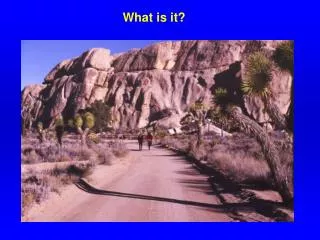
What is it? Normal faults generally place younger and/or lower-grade rocks (in HW) on top of older and/or higher-grade rocks (in FW) HW young low-grade “dirt” FW old high-grade gneiss
Normal faults generally place younger and/or lower-grade rocks (in HW) on top of older and/or higher-grade rocks (in FW) What is it? Cambrian limestone FW HW Tertiary conglomerate
Thrust fault (reverse fault): hanging wall moves upward relative to footwall What is it? HW FW
Thrust faults generally place older and/or higher-grade rocks (in HW) on top of younger and/or lower-grade rocks (in FW)
Thrust faults generally place older and/or higher-grade rocks (in HW) on top of younger and/or lower-grade rocks (in FW)
Thrust faults generally place older and/or higher-grade rocks (in HW) on top of younger and/or lower-grade rocks (in FW) What is it? HW sandstone low grade blueschist FW high grade
Slip vs. Separation Slip: ACTUAL relative displacement Separation: APPARENT relative displacement
A natural example demonstrating that apparent separation can be much different than true slip!
The key to describing slip along a fault lies in measuring (1) Direction of displacement (2) Sense of displacement (3) Magnitude of displacement
Listric: curved faults that flatten with depth listric normal fault
Map Symbols: a start • Strike-slip fault • Normal fault • Thrust fault
Next lecture: Intro to folds Read pgs. 372-413
Announcements: Field trip to Cottonwood Canyon this Saturday - meet at 7:45 am at the loading dock! Bring pencils, protractor Will it rain? Rain gear Will it be hot? Sunscreen lotion Hiking boots, water, lunches Will be back around 4 pm.