Common Ion Effect
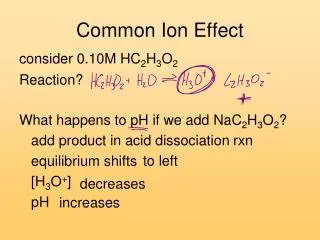
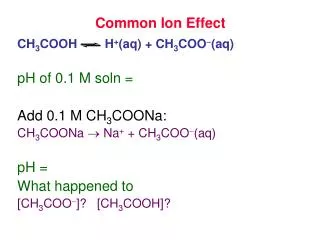
The common ion effect describes how the addition of an ion that is part of a reversible reaction shifts the equilibrium. For example, when 0.100 moles of sodium acetate (NaC2H3O2) is added to 1 L of a 0.100 M acetic acid (HC2H3O2) solution, it affects the pH by increasing acetate ion concentration. In another example, consider a solution with 10 moles of HCl and 20 moles of HF; calculating the fluoride concentration and pH demonstrates the impact of common ions. Additionally, we can calculate the % dissociation of HF in a 1.0 M HF and 1.0 M NaF solution using the common ion effect.


Common Ion Effect
E N D
Presentation Transcript
Definition • Shift in equilibrium that occurs when we add an ion that is a component of an equilibrium reaction
Example • Suppose that we add .100 mole of sodium acetate, NaC2H3O2 , to 1 L of .100 M solution of acetic acid, HC2H3O2 . What is the pH of the solution?
Example • Calculate the fluoride concentration and pH of a solution containing .10 mole of HCl and .20 mole of HF in a liter of solution.
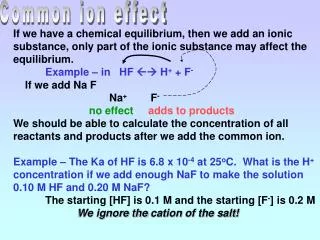
Example • Calculate the % dissociation of HF in a solution containing 1.0M HF and 1.0M NaF.