Understanding Finite Automata and Regular Languages
Learn about finite automata, regular languages, formal definitions, language operations, NFA, DFA, and more. Explore examples and theorems in automata theory.

Understanding Finite Automata and Regular Languages
E N D
Presentation Transcript
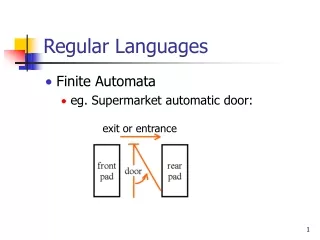
Regular Languages • Finite Automata • eg. Supermarket automatic door: exit or entrance
Finite Automata Input signal Statetransitiontable Doorstate Statediagram
Definition • A finite automaton is a 5-tuple (Q, , , q0, F) • Q : a finite set called the states • : a finite set called the alphabet • : QxQ is the transition function • q0Q is the start state • F Q is the set of accept states final states
M1 = (Q, , , q0, F) • Q = {q1, q2, q3} • = {0, 1} • : 0 1 q1 q1 q2 q2 q3 q2 q3 q2 q2 • q1: the start state • F = {q2} L(M) = AM recognizes A orM accepts Athe set of all strings that M accepts L(M1) = ?
q2q3q2q3q2q3 100000101011 Eg: M2: M2=({q1,q2}, {0,1}, , q1, {q2}) : 0 1q1 q1 q2 q2 q1 q2 L(M2) =? L(M2) = {w | w ends in a 1}
M3: L(M3)={ or ends in 0} L(M3)=?
={<RESET>, 0, 1, 2} M5: 1 0 <RESET> 2 2 <RESET> 0 1 2 What is the language accepted by the above automata?
={<RESET>, 0, 1, 2} M5: L(M5) = {w | the sum of the symbols in w is 0 modulo 3 except the <RESET> resets to 0}
Formal definition of computation • M = (Q, , , q0, F) w : a string over , wi, w =w1w2…wn • M accepts w if a sequence of states r0, r1, …, rn exists in Q and satisfies the following 3 conditions: • r0 = q0 • ( ri, wi+1) = ri+1, for i = 0, …, n-1 • rn F
We say that M recognizes language A ifA = {w | M accepts w} • Def:A language is called a regular language if some finite automata recognizes it.
Designing finite automata • Let A = {w | w is 0-1 string and w has odd number of 1} • Is A a regular language ? • What is the automata accepting A ?
Designing finite automata • eg: Design a finite automaton to recognize all strings that contains 001 as a substring
Regular operations • A, B : languages Regular operations : union, concatenation, star • Union : AB = {x | x A or x B} • Concatenation : A。B = {x y | x A and y B} • Star : A* = {x 1x 2…x k | k 0 and each x iA }
Regular operations • eg: = { a, b, c, …, z} (26 letters)A = { good, bad}B = { boy, girl} • AB = { good, bad, boy, girl}A。B= {goodboy, goodgirl, badboy,badgirl}A* = {, good, bad, goodbad, badgood, goodgood, badbad, goodgoodgood, goodgoodbad, ………}
eg. A1={w | w has odd number of 1} • Q1= {qeven, qodd} • = {0,1} • 1:0 1 qeven qeven qoddqodd qodd qeven • qeven : start state • qodd : accept state
eg. A2={w | w has a 1} • Q2 = {q1, q2} • = {0,1} • 2: 0 1 q1 q1 q2 q2 q2 q2 • q1: start state • q2: accept state
A1A2={w | w has odd number of 1 or w has a 1} • Q= {(qeven,q1), (qeven,q2), (qodd,q1), (qodd,q2)} • = {0, 1} • :0 1 (qeven, q1) (qeven, q1) (qodd, q2) (qeven, q2) (qeven, q2) (qodd, q2) (qodd, q1) (qodd, q1) (qeven, q2) (qodd, q2) (qodd, q2) (qeven, q2) • (qeven, q1): start state • (qodd, q1)(qodd, q2)(qeven, q2): accept state
Theorem:The class of regular languages is closed under the union operation(in other words, if A1 and A2 are regular languages, so is A1A2)
Pf : LetM1 recognize A1, where M1= (Q1, , 1, q1, F1)M2 recognize A2, where M2= (Q2, , 2, q2, F2)Goal: Construct M=(Q, , , q0, F) to recognize A1 A2 • Q={(r1,r2)|r1Q1 and r2 Q2} • is the same in M1, M2 • For each (r1, r2)Q and each a, let((r1,r2), a)=(1(r1,a), 2(r2,a)) • q0=(q1, q2),(q0 is a new state Q1Q2) • F={(r1, r2)|r1 F1or r2 F2}
Theorem:The class of regular languages is close under the concatenation(in other words, if A1 and A2 are regular languages, so is A1。A2)
Nondeterminism: • eg. DeterministicComputation Non DeterministicComputation
eg: A : the language consisting of all strings over {0, 1} containing a 1 in the 3rd position from the end
eg: What does the following automaton accept? 1. 2.
Formal definition of a nondeterministic finite automaton • = {},P (Q) : the collection of all subset of Q • A nondeterministic finite automaton is a 5-tuple ( Q, , , q0, F), where • Q : a finite set of states • : a finite set of alphabet • : QxP (Q) transition function • q0Q : start state • F Q : the set of accept states
eg. • Q = {q1, q2, q3, q4} • = {0, 1} • : 0 1 q1 {q1}{q1, q2}q2 {q3} {q3}q3 {q4}q4 {q4}{q4} • q1 : start state • q4 : accept state
N=(Q, , , q0, F ) ~NFAw : string over , w= y1 y2 y3…ym , yir0,r1,r2,…,rm Q • N accepts w if exists r0,r1,r2,…,rm such that • r0=q0 • ri+1 (ri ,yi+1), for i =0,…m-1 • rm F
Equivalence of NFA and DFA • Theorem : Every nondeterministic finite automaton has an equivalent deterministic finite automaton • Pf: Let N=(Q, , , q0, F) be the NFA recognizing A. Goal: Construct a DFA recognizing A 1. First we don’t consider . Construct M= ( Q’, , ’, q0’, F’) 1. Q’= P(Q) 2. For RQ’ and a let 3. q0’= {q0} 4. F’ = {RQ’ | R contains an accept state of N}
Equivalence of NFA and DFA 2. Consider : For any RM, define E(R)={q | q can be reached from R by traveling along 0 or more } Replace (r,a) by E((r,a)) Thus, ’(R, a)={qQ : qE((r,a)) for some rR} Change q0’to be E({q0})
Corollary: A language is regular if and only if some NFA recognizes iteq.D’s state : {,{1}, {2}, {3}, {1,2}, {1,3}, {2,3}, {1,2,3}} N4 = ({1,2,3}, {a,b}, , 1, {1})
eg. Convert the following NFA to an equivalent DFA • E({q0}) = {q0} E(({q0},a)) = {q1,q2} E(({q0},b)) = E(({q1,q2},a) = {q1,q2} E(({q1,q2},b) = {q0}
Closure under the regular operations • Theorem : The class of regular language is closed under the union operation • Pf:A1: N1:A2: N2: • N1=(Q1, , 1, q1, F1) for A1 • N2=(Q2, , 2, q2, F2) for A2 A1A2
Construct N=(Q, , , q0, F) to recognize A1A2 • Q : {q0} Q1 Q2 • q0 : start state • F : F1 F2 • For qQ and a(q, a)= 1(q, a), qQ1 2(q, a), qQ2 {q1, q2}, q=q0 and a= , q=q0 and a
Theorem : The class of regular language is closed under the concatenation operation • Pf:N1: N2: • N1=(Q1, , 1, q1, F1) recognize A1 • N2=(Q2, , 2, q2, F2) recognize A2 A1。A2
Construct N=(Q, , , q1, F2) to recognize A1。A2 • Q : Q1 Q2 • q1 : start state • F2 : accept state • (q, a) = 1(q, a), qQ1 and qF1 1(q, a), qF1 and a 1(q, a){q2}, qF1 and a= 2(q, a), qQ2 qQ, a
Theorem : The class of regular language is closed under the star operation • Pf:A: A*: • N1=(Q1, , 1, q1, F1) recognize A A = {a, b} A* = {, a, b, …} , A A。A = {aa, ab, ba, bb} A。A。A…
Construct N=(Q, , , q0, F) to recognize A* • Q : {q0} Q • q0 : start state • F : {q0} F • (q, a) = 1(q, a), qQ1 and qF1 1(q, a), qF1 and a 1(q, a){q1}, qF1 and a= {q1}, q=q0 and a= q=q0 and a
Regular Expressions • AWK, GREP in UNIXPERL, text editors. • eg.(01)0* = ({0}{1})。{0}* • eg.(01)* = {0, 1}*
Formal definition of a regular expression • Definition:R is a regular expression if R is • a • • • (R1R2), R1 and R2 are regular • (R1。R2), R1 and R2 are regular • (R1* ), R1 is regular expression Inductive definition
eg. = {0, 1} • 0*10* = {w : w has exactly a single 1} • *1* • *001* • ()* • 01 10 • 0*0 1*1 0 1 • (0)1*=01*1* • (0)(1) = {, 0, 1, 01} • 1* = • * = {}
eg.R : regular expressionR = RR。 = R • R ?=R R。 ?= R R = {0}R。 =
Equivalence with finite automata • Theorem:A language is regular if and only if some regular expression describes it • Lemma: ()If a language is described by a regular expression then it is regular
Pf:Let R be a regular expression describing some language AGoal: Convert R into an NFA N. • R=a , L(R)={a} • R=, L(R)={} • R=, L(R)= • R = R1R2 • R = R1。R2 • R = R1*
eg. (ab a)* • a • b • ab • ab a • (ab a)*
eg. (a b)*aba • a • b • a b • (a b)* • aba
Generalized nondeterministic finite automaton (GNFA) • ( Q, , , qstart, qaccept) : (Q - {qaccept}) x (Q - {qstart}) R Set of all regular expressions over (qi, qj) = R