Chemistry Jeopardy
Explore the foundational concepts of atomic theory and notable discoveries in chemistry. From the earliest ideas proposed by Greek philosophers to the groundbreaking experiments of scientists like Rutherford and Chadwick, understand the evolution of atomic models. Learn about the charge-to-mass ratio of electrons, the gold foil experiment, and the characteristics of isotopes. This overview also addresses changes made to Dalton's atomic theory, elemental safety symbols, and practical measurements in chemistry. Delve into the significant contributors and principles that shaped our understanding of matter.

Chemistry Jeopardy
E N D
Presentation Transcript
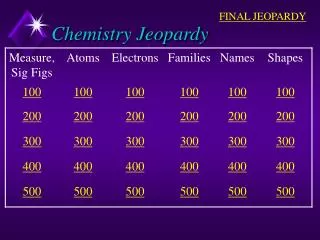
This Greek presented the idea that all matter is made up of atoms
The number of these particles is different in isotopes of the same element
In his version of the atomic theory, he (incorrectly) argued that atoms are not divisible
While working under under Rutherford, he developed a new model of the atom – sometimes called the planetary model
Dalton used these two fundamental chemistry laws to create his atomic theory
Identify the isotope that has 49 neutrons and a mass number of 87
Even though we know of 123, only this many elements are naturally occurring
If 1 zam equals 5 bams, find the volume of a rectangular solid that measures 2 zams by 10 bams by 5 bams