The Evolution and Market Dynamics of Object-Oriented Databases
This comprehensive overview explores the development of object-oriented programming and databases from the 1960s to the 1990s, highlighting pivotal languages like Simula, Smalltalk, C++, and Java. We delve into the distinguishing features of object-oriented databases (OODBMS) and compare them with relational database management systems (RDBMS), illustrating market sizes and key players. Key characteristics such as encapsulation, inheritance, and polymorphism are discussed, alongside examples of querying in both OODBMS and SQL, providing insights into their practical applications.

The Evolution and Market Dynamics of Object-Oriented Databases
E N D
Presentation Transcript
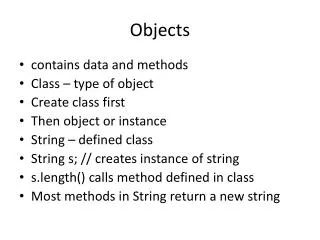
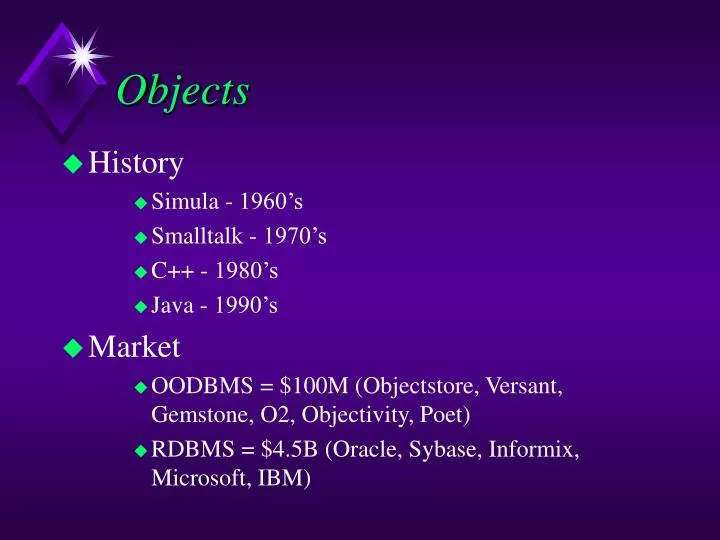
Objects • History • Simula - 1960’s • Smalltalk - 1970’s • C++ - 1980’s • Java - 1990’s • Market • OODBMS = $100M (Objectstore, Versant, Gemstone, O2, Objectivity, Poet) • RDBMS = $4.5B (Oracle, Sybase, Informix, Microsoft, IBM)
An object is a data structure... • Data • Behavior • what operations the object can perform • how it responds to messages from other objects
OO Environment Message A Message B Method 1 Method 3 Data Data Method 5 Method 4 Method 2 Message C
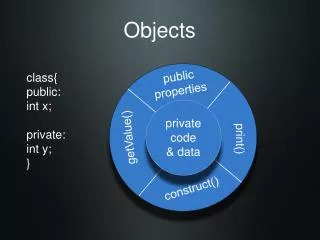
OO Features • Complex objects • Identity • Encapsulation • Classes • Inheritance • Extensibility • Polymorphism Object Class Attributes Methods
Object Oriented Databases • Object • unique system generated object identifier • collection of procedures • regular data attributes • Messages • Encapsulation • Classes • Hierarchy • Inheritance • Polymorphism
Object Oriented Databases • Extensibility • Integer, Real, String, Date, Char, Boolean • Tuple, Set, List, Array, Bag • Image, Audio, Video • User Defined Abstract Data Types (!) • Persistence • Object state is implicitly saved
Object Behavior • Methods • objects are self-contained • supports object independence (private/public) • Msg: person.new person.firstName(“Chuck”) person.age return(year(today - birthdate))
Polymorphism • Object methods can have the same name and similar behavior, or same name and different behavior. • Example - computeYearlyEarnings • non-union vs. union employee
Querying OODBMS • Consider the table: • Person{LastName,Spouse,Mother,Father} • Find “David Jordan's” wife's mother's father (Grandfather in law?)
In SQL select f.last_name from Person me, Person sp, Person m, Person f where me.first_name = "David' and me.last_name = "Jordan" and me.spouse = sp.personId and sp.mother = m.personId and m.father = f.personId
In OQL David_Jordan->Spouse->Mother->Father->LastName
Another Example list of all the last names in the database that were not "Smith" or "Jones": OQL: select distinct LastName from Persons where LastName != "Smith" and LastName!= "Jones" SQL: select distinct LastName from Persons where LastName <> "Smith" and LastName <> "Jones"
When to use an OODBMS? • If the requirements analysis lends itself to object design, and the development language is object-oriented, then • If the data is not already stored in an RDBMS, then use OODBMS • Else, use O/RDBMS.