Engineering Output Formatting for Electrical Values with Significant Figures
This document outlines a method for formatting engineering outputs, particularly for electrical values like voltage and current, using a notation similar to scientific notation. Key components include transforming values into mantissas and exponents, normalizing them, applying appropriate SI unit prefixes, and rounding to the correct number of significant figures. The algorithm involves several tasks to manage negative signs, determine significances, and output values correctly formatted for clarity and precision, ensuring values remain within standardized engineering notation.

Engineering Output Formatting for Electrical Values with Significant Figures
E N D
Presentation Transcript
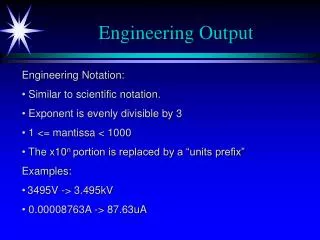
Engineering Output • Engineering Notation: • Similar to scientific notation. • Exponent is evenly divisible by 3 • 1 <= mantissa < 1000 • The x10nportion is replaced by a “units prefix” • Examples: • 3495V -> 3.495kV • 0.00008763A -> 87.63uA
Engineering Output Function int PutV_Eng(double v, int sigfigs, char *units) v : Value to be output sigfigs : number of sig figs to display units : string containing the units name to append. RETURNS: Number of characters printed.
Significant Figures • Measure of the accuracy and/or precision of a value. • Values are assumed known to +/- 0.5 sig fig. • Determines how many digits are reported. • By convention, a leading 1 is not considered significant. • By convention, trailing zeroes not considered significant. • Examples: • 3.495kV has 4 sig figs. • 17.63uA has 3 sig figs. • 400m has 1 sig fig. (unless told otherwise).
Rounding • Round to nearest least significant digit. • Visually, we look to see if the next digit is 5 or greater. • Our output algorithm automatically truncates (ignores) any digits to the right of the last digit output. • Algorithmically, we can simply add 0.5 sig fig and truncate. • Examples: • 4.53243 rounds to 4.532 with 4 sig. figs. • 4.53243 + 0.0005 = 4.532 | 93 (only output 4 digits) • 2.38954 rounds to 2.39 with 3 sig figs. • 2.38954 + 0.005 = 2.39 | 454 (only output 3 digits)
Rounding Normalized Values In scientific notation, the value v can be expressed using a mantissa (m) and an exponent (e) as follows: v = m x 10e This value is normalized if m has exactly one non-zero digit to the left of the decimal point, i.e, if: 1.0 <= m < 10.0 Ignoring significant of leading 1 (for now), 0.5 sig fig is then: hsf = 5 x 10-N (hsf - “hemi-sig fig) If m has a leading 1, then hsf is another factor of ten smaller: hsf = 0.5 x 10-N
Top Level Decomposition 1) TASK: Output negative sign and take absolute value. 2) TASK: Determine the mantissa and the exponent. 3) TASK: Add 0.5 Sig Fig to Mantissa 4) TASK: Scale mantissa so that exponent is divisible by 3. 5) TASK: Output mantissa to N sig figs. 6) TASK: Output prefix based on exponent. 7) TASK: Output units. 8) TASK: Return number of characters printed.
Hand Example v = -0.00001846774 to 4 sig figs 1) TASK: Output negative sign and take absolute value. OUTPUT: ‘-’ v = 0.00001846774 2) TASK: Determine the mantissa and the exponent. m = 1.846774 e = -5 3) TASK: Add 0.5 Sig Fig to Mantissa hsf = 5 x 10-4 = 0.0005 hsf = hsf/10 = 0.00005 (since m < 2) m = m + hsf = 1.846774 + 0.00005 = 1.846824
Hand Example (cont’d) 4) TASK: Scale mantissa so that exponent is divisible by 3. e = -4 not divisible by 3. Multiply mantissa by 10 and decrement exponent until it is. m = 18.46824 e = -3 5) TASK: Output mantissa to N sig figs. Output m to (N+1 digits since leading digit was a 1) OUTPUT: 18.468 6) TASK: Output prefix based on exponent. OUTPUT: m 7) TASK: Output units.
PutV_Eng() Task 1 int PutV_Eng(double v, int sigfigs, char *units) { int i, c, e; double m, hsf; /* TASK 1 - Handle negative values */ if (n < 0.0) { PutC(‘-’); return 1 + PutV_Eng(-v, sigfigs, units); }
PutV_Eng() Task 2 /* TASK 2 - Determine mantissa and exponent */ m = 0.0; e = 0; if (v != 0.0) { while (v >= 10.0) { v /= 10.0; e++; } while (v < 1.0) { v *= 10.0; e--; } }
PutV_Eng() Task 3 /* TASK 3 - Add 0.5 sig fig */ hsf = (m < 2.0)? 0.5 : 5.0; for (i = 0; i < sigfigs; i++) hsf /= 10.0;
PutV_Eng() Task 4 /* TASK 4 - Make exponent divisible by 3 */ while (e%3) { m *= 10.0; e--; }
PutV_Eng() Task 5 /* TASK 5 - Output Mantissa */ c = PutV_lfN(m, sigfigs + ((m<2.0)? 1 : 0) ); /* The PutV_lfN() function is basically the PutV_lf() function except that it only puts out N digits (followed by trailing zeros if necessary). */
PutV_Eng() Task 6 /* TASK 6 - Output Prefix */ switch(e) { case -24: PutC(‘y’); c++; break; case -21: PutC(‘z’); c++; break; /* ... */ case -3: PutC(‘m’); c++; break; case 0: break; case 3: PutC(‘k’); c++; break; /* ... */ case 21: PutC(‘Z’); c++; break; case 24: PutC(‘Y’); c++; break; default: PutC(‘e’); c += 1 + PutV_i(e); }
PutV_Eng() Task 7 / 8 /* TASK 7 - Output Units */ c += PutS(units); /* TASK 8 - Return number of characters */ return c; }