Download
1 / 13
240 likes | 711 Vues
This document provides a comprehensive overview of gold skarn deposits, focusing on their classification, geology, and mineralogy. It examines the characteristics and distribution of major gold skarn deposits, including intrusion-related and Carlin-type gold deposits, as well as epithermal deposits in volcanic terrains. Key exploration criteria for economic gold skarn deposits are suggested, highlighting the importance of skarn mineralogy, particularly garnet and pyroxene, as well as the roles of reducing environments and hydrothermal interactions in gold deposition.

E N D
Gold skarn Deposits - Geology and Exploration Criteria -
Object • To understand and classify Skarn deposits • To understand geology,mineralogy, characteristics, and distributions from mainSkarngold deposits • Suggest relevant exploration criteria for economic skarn gold deposits
Classification of gold deposits • Intrusion-related gold deposits • Carlin-type gold deposits in Nevada, USA • Epithermal gold deposits in volcanic terranes
“Skarn” • Originally a term applied to coarse-grained calc-silicate gangue associated with the iron ore deposits of Sweden • It include a variety of calc-silicate rocks rich in calcium, iron, magnesium, aluminium, manganese that formed by replacement of originally carbonate-rich rocks. • Skarn deposits result from the hydrothermal interaction of hot silicate magmas and cooler sedimentary rocks
Gold type Iron type Copper type : nonpophyritic, small-size, high- gold grade in high sulfide content, intense retrograde alteration Porphyry copper type : Large-scale and low-gold grade Lead-zinc type : very little gold contain The type of skarn deposits(Enaudi et al., 1981)
Fig.2 Distribution of Au, Ag, and Cu in skarn, pluton, and protolith of a large copper skarn system, Whitehorse copper belt, Canada (from Meinert, 1986)
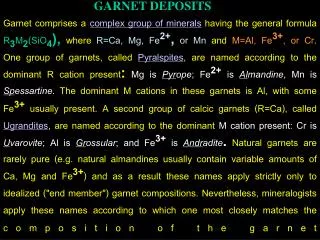
Skarn gold deposits • Related to copper-mineralized porphyritic intrusions • Usually clastic or volcanoclastic component • Age : Cambrian or older ~ Miocene • Arsenopyrite and pyrrhotite are abundant • Typically contain As, Bi, Te
Fig. 3. Electron microprobe analysis (mole%) of garnet and pyroxene from Fortitude, Nevada ; Hedley, British Columbia; Mccoy, Nevada: west central Montana gold skarn.
Summary and Exploration Criteria • Skarn mineralogy (especially, garnet and pyroxene) is the key to explore skarn deposits. • The abundance of pyroxene relative to garnet and the high ferrous/ferric ratios reflect the generally reducing environment of gold skarns. • Reducing conditions and subsequent oxidation is important in skarn gold deposition
Most gold skarns are associated with relatively mafic reduced plutons and contain anomalous of As, Bi, and Te. Explorationists should noted that the more proximal gold-poor, garnet-rich part of a skarn deposit is likely to be more resistant to erosion and thus more likely to crop out and be sampled than the more distal gold and pyroxene-rich skarn. Economic gold skarns should be sought in the distal part of under reducing conditions.