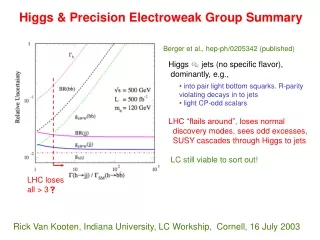
V. Electroweak Precision Observables
This work explores the role of radiative corrections in understanding weak decays and electroweak precision observables (EWPO). By examining processes such as muon decay and charged and neutral current interactions, we investigate how radiative corrections inform us about particle spectra through parameters derived from loop corrections. The study emphasizes the significance of the Fermi constant and the implications of different processes in probing the underlying particle interactions. Additionally, the article discusses constraints on model parameters derived from global fits to EWPO.

V. Electroweak Precision Observables
E N D
Presentation Transcript
V. Electroweak Precision Observables • What radiative corrections can teach us • Basic formalism
g g Weak Decays: GFencodes information on the spectrum via radiative corrections Muon Decay Drm depends on parameters of particles inside loops
g g Comparingradiative corrections in different processes canprobeparticle spectrum Drm differs fromDrZ
Comparingradiative corrections in different processes canprobeparticle spectrum
Charged Current Interactions I G.B. Propagator Fermion Propagator Vertex Correction Box (finite)
Muon decay at one loop: Muon lifetime: Vertex, box, fermion prop Fermi constant & r : Tree level Charged Current Interactions II
Complication: Z mixing Neutral Current Interactions I G.B. Propagator Fermion Propagator Vertex Correction Box (finite)
Normalize to G: Remove r Vertex & ext leg Neutral Current Interactions II Neutral current l+f --> l+f at one loop: Normalization: Vector & axial vector couplings: Weak mixing:
The parameter: Weak mixing: Can impose constraints from global fits to EWPO via S,T,U-dependence of these quantities Oblique Parameters I G.B. Propagators
Oblique Parameters II Fit to electroweak precision observables: G.B. Propagators mH = 114.4 GeV Plus low-energy observables: atomic PV, PV electron scattering, scattering…