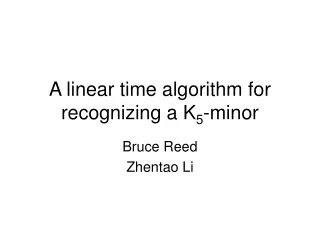
A New Linear Algorithm for Checking Graph 3-Edge-Connectivity
This paper presents an efficient algorithm for determining whether a graph is 3-edge-connected in O(m+n) time, leveraging depth-first search techniques. The algorithm modifies earlier methods by Hopcroft and Tarjan to decompose graphs into their 3-vertex-connected components. Key concepts include separation pairs, vertex connectivity, edge connectivity, and practical applications such as network reliability and planar graph analysis. The study is an essential contribution to graph theory and has implications for enhancing the robustness of network structures.

A New Linear Algorithm for Checking Graph 3-Edge-Connectivity
E N D
Presentation Transcript
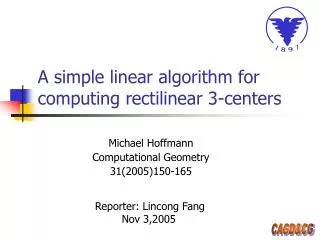
A new linear algorithm for checking a graph for 3-edge-connectivity Feng Sun Advisor: Dr. Robert W. Robinson Committee: Dr. E. Rodney Canfield Dr. Eileen T. Kraemer 2003.2
Outline • Overview • Concepts and definitions • Analysis of separation pairs • Test results
Graph Connectivity • Applications • Network reliability • Planar graph • Vertex Connectivity (κ) • Edge Connectivity (λ) • Our algorithm • Check whether a graph is 3-edge-connected in O(m+n) time • Based on Depth-first search • Modified from the algorithm of Hopcroft and Tarjan to divide a graph into 3-vertex-connected components
Concepts • Graph • An ordered pair of disjoint sets (V, E), where V is the vertex set and E is the edge set. E is a subset of the set V(2)of unordered pairs from V. • The order of a graph is |V| and the size of a graph is |E|. • A graph is labeled if the integers from 1 through n are assigned to its vertices. An unlabeled graph is an isomorphism class of labeled graphs. • Tree • Acyclic connected graph • A subgraph which contains all the vertices of a graph is the spanning tree of the graph • Edge separator • A minimal edge set S such that removal of S from a graph G disconnect G. • A graph is k-edge-connected if every edge-separator has at least k edges. • The edge connectivity of a graph G of order n ≥ 2 is the minimum cardinality of an edge-separator.
Concepts (cont.) • Palm tree • Let P be a directed graph consisting of two disjoint sets of edges denoted by v→w and v --→w. P is a palm tree if P satisfies the following properties: • The subgraph T containing the edges v→w is a spanning tree of P. • If v --→w, then w*→v. That is, each edge not in the spanning tree of P connects a vertex with one of its ancestors in T. The edges v --→w are called the fronds of P. 1 2 3 4
Depth-first Search ALGORITHM DFS(G) 1 FOR each vertex v in V(G) 2 NUMBER(v) = FATHER(v) = 0; 3 time = 0; 4 DFS-VISIT(root); END ALGORITHM PROCEDURE DFS-VISIT(v) 1 NUMBER(v) = time = time + 1 2 FOR w in the adjacency list of v DO 3 { 4 IF NUMBER(w) == 0 THEN 5 { 6 mark vw as a tree edge in P; 7 FATHER(w) = v; 8 DFS-VISIT(w); 9 } 10 ELSE IF NUMBER(w) < NUMBER(v) and w != FATHER(v) THEN 11 mark vw as a frond in P; 12 }
Identifying separation pairs • Three cases if a graph G is not 3-edge-connected • Not connected • Connected but not 2-edge-connected • 2-edge-connected but not 3-edge-connected • Separation pair
a w u t v G1 G1 d x v (a) Type 1 (b) Type 2 Two types of separation pairs in a palm tree • Type 1: One tree edge, one frond • Type 2: Two tree edges
An Expanded DFS PROCEDURE FIRSTDFS-VISIT(v) 1 NUMBER(v) = time = time + 1; 2 LOWPT1(v) = LOWPT2(v) = NUMBER(v); 3 ND(v) = 1; 4 FOR w in the adjacency list of v DO 5 { 6 IF NUMBER(w) == 0 THEN 7 { 8 mark vw as a tree edge in P; 9 FATHER(w) = v; 10 FIRSTDFS-VISIT(w); 10.1 IF ( LOWPT1(w) < v and LOWPT2(w) >= w ) THEN 10.2 detect a type 1 separation pair, procedure stop; 11 IF LOWPT1(w) < LOWPT1(v) THEN 12 { 13 LOWPT2(v) = MIN{LOWPT1(v), LOWPT2(w)}; 14 LOWPT1(v) = LOWPT1(w); 15 } 16 ELSE IF LOWPT1(w) == LOWPT1(v) THEN 17 LOWPT2(v) = LOWPT1(w); 18 ELSE 19 LOWPT2(v) = MIN{LOWPT2(v), LOWPT1(w)}; 20 ND(v) = ND(v) + ND(w); 21 } 22 ELSE IF NUMBER(w) < NUMBER(v) and w != FATHER(v) THEN 23 { 24 mark vw as a frond in P; 25 IF NUMBER(w) < LOWPT1(v) THEN 26 { 27 LOWPT2(v) = LOWPT1(v); 28 LOWPT1(v) = NUMBER(w); 29 } 30 ELSE IF NUMBER(w) == LOWPT1(v) THEN 31 LOWPT2(v) = NUMBER(w); 32 ELSE 33 LOWPT2(v) = MIN{LOWPT2(v), NUMBER(w)}; 34 } 35 }
a LOWPT1(w) u w x LOWPT2(w) ≥ w Identify type 1 separation pair
Decrease A(1) A(1) B(2) Decrease B(2) F(6) F(6) C(3) C(3) G(7) H(8) H(8) G(7) E(4) Preparation Steps for type 2 pair (cont.) (ii) After D(5) D(4) E(5) (i) Before
Identify type 2 separation pair 1 u a y1 2 v x1 y2 b 3 x2
The DFS to identify type 2 pair PROCEDURE PATHSEARCH-DFS(v) (input: vertex v is the current vertex in the depth-first search) 1 FOR w IN A(v) DO 2 { 3 IF vw is a tree edge THEN 4 { 5 IF vw is a first edge of a path THEN 6 { 7 IF LOWPT1(w) < LOWEST(v) and w is not A1(v) THEN 8 LOWEST(v) = LOWPT1(w); 9 add end-of-stack marker to PStack; 10 } 11 returnVal = PATHSEARCH-DFS(w); 12 IF returnVal == 0 THEN 13 return 0; 14 } 15 ELSE // vw is a frond 16 IF NUMBER(w) < LOWEST(v) THEN 17 LOWEST(v) = NUMBER(w); 18 } 19 WHILE (a, b) on PStack satisfies a <= NUMBER(v) < b and LOWEST(v) < a 20 remove (a, b) from PStack; 21 IF no pair deleted from PStack THEN 22 add ( LOWEST(v), A1(v) ) to PStack; 23 IF (a, b) is the last pair deleted from PStack THEN 24 add ( LOWEST(v), b ) to PStack; 25 WHILE (a, b) on PStack satisfies a <= NUMBER(v) < b and HIGHPT(v) >= b 26 remove (a, b) from PStack; 27 WHILE (a, b) on PStack satisfies a = v 28 { 29 IF ( b <= a or a == 0 ) THEN 30 delete (a, b) from PStack; 31 ELSE //we find type 2 pair {(FATHER(a), a), (FATHER(b), b)} 32 return 0; 33 } 34 IF ( FATHER(v), v) is a first edge of a path THEN 35 delete all entries on PStack down to and including end-of-stack marker; 36 return 1;
parent(LOWEST(v)) a’ LOWEST(v) a a v v b w b w x highpt(v) Cases for lines 20 and 26 If LOWEST(v) < a, (parent(LOWPT1(w)), LOWPT1(w)) and (parent(b), b) become the new potential separation pair. We use (b, lowest(v) ) to substitute (b, a) in the PStack. If hightpt(v) >= b, (a, b) will be deleted from PStack.
0 2 3 4 1 Implementation and Test Results • General graph • Check graphs generated by Nauty • Numbers of labeled and unlabeled 3-edge-connected graphs up to order 11. • Numbers of labeled and unlabeled 3-edge-connected blocks up to order 11. • The above numbers for labeled graphs and for unlabeled 3-edge-connected blocks were provided by S. K. Pootheri. • Compare with Z. Chen’s algorithm for higher order random graphs • Feynman diagrams • Compare with Qun Wang’s quadratic algorithm 5
Numbers of unlabeled and labeled 3-edge-connected graphs by order n
Numbers of unlabeled 3-edge-connected graphs by order n and size m
Average testing times and scaled times for two algorithms on random graphs • For each 100 random graphs were generated and about half of them are 3-edge-connected • The scaled time is the actual testing time divided by m+n
Comparison of running times and scaled times for 3-edge-connectivity
Comparison of running times for our linear algorithm and a quadratic algorithm on Feynman diagrams • Use a simplified algorithm for Feynman diagram • Feynman diagrams were generated by a program wrote by Dr. Robinson • Q. Wang developed three algorithm for testing 3-edge-connectivity of a Feynman diagram. The quadratic algorithm is the best for order less than 12
Conclusions and future work • A new linear algorithm for determining whether a graph is 3-edge-connected is presented. • A variation of the algorithm was developed specifically for testing Feynman diagrams. • Tests showed that the implementations are correct and also faster than the available alternatives. • A promising future direction is to extend our algorithm to deal with fully dynamic 3-edge-connectivity problem.
Acknowledgements • Dr. Robert W. Robinson • Dr. E. Rodney Canfield • Dr. Eileen T. Kraemer • Dr. David K. Lowenthal • Other professors, staffs and students in our department