Download
1 / 5
50 likes | 163 Vues
On May 18, 2007, William Gerstenmaier, NASA's Associate Administrator for Space Operations, outlined the ISS Cargo Supply Strategy, which involves a mixed fleet including ATV, HTV, Progress, and US domestic cargo service providers. The strategy emphasizes immediate acquisition of domestic delivery services and leverages international barters per original ISS agreements. Russian cargo delivery services will provide a necessary bridge before US commercial capabilities become operational, ensuring ISS survival amid expected shortfalls in supplies. Procurement of US commercial services is projected for 2010 to meet remaining needs.

E N D
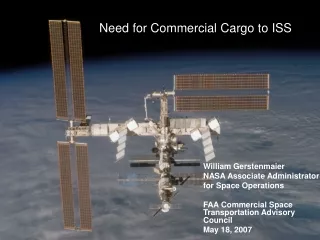
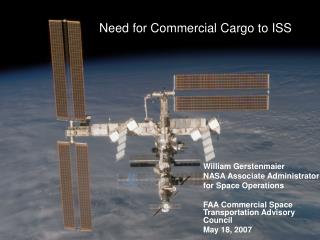
Need for Commercial Cargo to ISS William Gerstenmaier NASA Associate Administrator for Space Operations FAA Commercial Space Transportation Advisory Council May 18, 2007
ISS Cargo Supply Strategy • NASA is developing an ISS Cargo Supply Strategy that uses a mixed fleet (ATV, HTV, Progresses and US domestic cargo service providers). • Strategy requires purchase of domestic delivery services as soon as available. • International Partner barters will also be used as identified in the original ISS agreements. • Purchase of Russian cargo delivery services will bridge the gap between Shuttle and the new US domestic cargo service providers. • Russian services are currently the only other proven upmass capability. • The Russian services that have been procured are the minimum needed for ISS survival; commercial services are projected to be required in 2010. • Once US commercial services are available, no other Russian cargo delivery services will be procured. ISS_CM_019
FY08 FY09 FY10 FY11 FY12 FY13 FY14 FY15 TOTAL Shortfall Requiring COTS: 3.0 5.8 10.0 10.0 10.0 10.0 48.8 Purchase Mass w/1.63 Packing Factor: 4.9 9.5 16.3 16.3 16.3 16.3 79.6 ISS Cargo Requirements Assessment • Initial Assessment of upmass requirements to support life of ISS has been performed. • Results indicated at least 48.8 metric ton shortfall beyond capabilities of: • Shuttle flyout (13+2+1) • ATV offset (3.4 of 5 flights will be US cargo) • HTV offset (4.3 of 7 flights will be US cargo) • Russian procurement (4.2 MT in ‘10 and 1.4 MT in ‘11) • Absolute minimum needed to ensure ISS survival in event of COTS delay. • Remaining shortfall to be met by US commercial services: • Refinement of cargo upmass requirements is ongoing. ISS_CM_019
ISSP Preparations for Commercial Services • Finalizing generic visiting vehicle interface requirements • Developing them for use during the COTS Phase I process • More than typical launch vehicle requirements—proximity operations, berthing, Station arm requirements, hatches, environment, etc • Continuing to evaluate future cargo requirements • Monitoring system performance (system hardware driver). • Monitoring crew usage (crew supplies driver). • Analyzing post Shuttle consumable requirements (water, gas, and propellant consumption). • Working with other government agencies who could use ISS as a national laboratory (e.g., NIH). • Initiated planning for commercial cargo services procurement • Evaluating when’s the right time to begin formal procurement activities • Weighing different contract structures and configurations • Assessing demonstration criteria for launch services and ISS proximity operations ISS_CM_019