Comprehensive Guide to Anatomy and Physiology for Sports Testing
This resource is designed to prepare students for Unit 1 of the Sports Anatomy and Physiology test. It covers essential topics, including anatomical positions, planes, axes of movement, skeletal system functions, types of bones, muscle structure and contractions, joint classifications, and common injuries. Key concepts such as hypertrophy, atrophy, and the ALL or none principle are also explained. The assessment format includes multiple choice, true/false, fill-in-the-blank, and short answer questions, providing a well-rounded evaluation of knowledge in sports science.

Comprehensive Guide to Anatomy and Physiology for Sports Testing
E N D
Presentation Transcript
Things I need to know... UNIT 1 TEst Sport Books Publisher
Stuff I need to know for the test: • Define: anatomy/physiology/exercise phys. • What is the correct anatomical position? • Know the planes and axis of movement • Be able to use anatomical terminology (ie: pronation, supination, dorsi flexion etc) • What is the function of the skeletal system? • Describe and give examples of 5 types of bones. Sport Books Publisher
Unit 1 test • Differentiate between axial and appendicular skeleton • What is the significance of a long bone? Label a long bone. • Label the bones on a human skeleton • What are the different types of factures? • What are the components of a motor unit? (dendrites, cell body, neuromuscular junction, ect. Sport Books Publisher
Unit 1 Test • What is the structure of a muscle? • How does a muscle contract? • What is the function of the agonist muscle? Antagonist? List basic pairs. • Differentiate WITH examples between isotonic, isometric, eccentric and conccentric contractions. Sport Books Publisher
Unit 1 Test • Know the functions/location of the muscles. • What is the main function of the muscular system? • Describe the different types of muscle (skeletal, cardiac, smooth) • Define: hypertrophy, transient hypertrophy, atrophy Sport Books Publisher
Unit 1 Test • Define: joint, ligament, tendon • Describe the 3 classes of joints • What are the types of joints, and where are they located? • What bones make up a shoulder joint? Knee joint? • How are bones formed? • What is the ALL or none principle. Sport Books Publisher
Unit 1 • What is osteoporosis? Arthritis? Tendonitis? • What does RICE stand for?SHARP? • Common injuries to the knee • What are the benefits of resistance training? • Label the knee joint. Sport Books Publisher
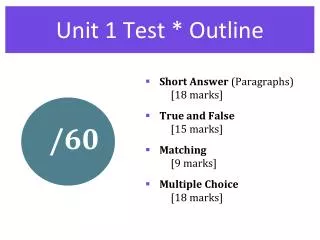
Unit Test Break Down • Multiple Choice (35 marks) • True of False (10 marks) • Fill in the Blank (10 marks) • Short Answer (15 marks) • Label – TBD Sport Books Publisher