Developmental Psychology
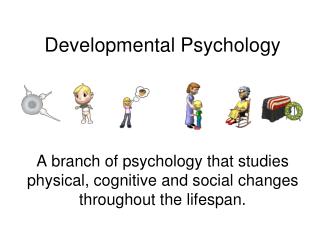
This overview of developmental psychology examines key concepts from prenatal development to adulthood. It discusses the impact of teratogens on fetuses, the process of habituation in newborns, and stages of cognitive development as proposed by Jean Piaget. It also explores social development, including attachment styles, parenting methods, and the influence of gender roles. The evolution of intelligence and social interactions throughout life stages, including factors affecting marriage and happiness, are highlighted.

Developmental Psychology
E N D
Presentation Transcript
Prenatal Development and the Newborn • Teratogens – harmful agents like viruses or drugs that affect a developing fetus • HIV, heroin, nicotine, alcohol
Newborns experience habituation: a decrease in responding with repeated stimulation • More often a newborn sees something, the less interested he is
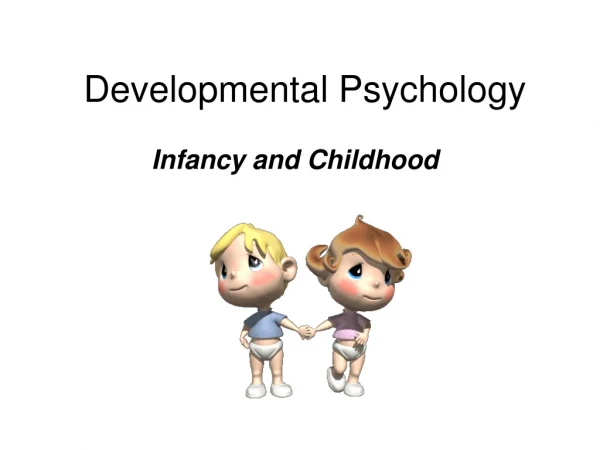
Infancy and Childhood • Brain cells are developed at birth, but neural networks grow with age • Motor development sequence (roll over, crawl, walk) is universal • Individual differences in timing • Infantile amnesia – our memories seldom predate our 3rd birthday
Cognitive development • Brain builds schemas or mental molds of our experiences • We assimilate or interpret new experiences in terms of existing schemas • Thinking all 4-legged animals are cows • We accommodate or adjust schemas to incorporate info from new experiences • Creating a cow category
Jean Piaget’s Stages of Cognitive Development • Sensorimotor stage – birth to age 2 • Know the world through senses and motor activities • Young infants lack object permanence – awareness that objects continue to exist when not perceived
Piaget -cont- • Preoperational stage – age 2 - 6 or 7 • Learns to use language but doesn’t understand logic • Doesn’t understand conservation – mass, volume and number stay the same despite changes in form • Pouring milk from a tall to a short container
Piaget -cont- • Egocentric – difficulty in taking another’s point of view • Age 4 or 5 begin to develop theory of mind – ability to infer others’ mental states
Piaget -cont- • Concrete Operational Stage – 6 or 7 years to 11 or 12 • Begin to think logically • Understands conservation and mathematical transformations
Formal Operational Stage – begins around age 12 • Begin to think logically about abstract concepts
Infant Social Development • 8 months: develop stranger anxiety – fear of strangers • Attachment bond • Secure attachment - 60% of infants in a “strange situation” play in mom’s presence, become upset when she leaves, seek contact w/her when she returns and calm down • Insecure attachment – less likely to explore, cling to mom, cry or remain indifferent when she leaves
Parenting Styles • Authoritarian – impose rules and expect obedience • Can result in less social skill and self-esteem • Permissive – give in; make few demands and use little punishment • Can result in aggression and immaturity • Authoritative – demanding and responsive; set rules but explain reasons behind them • Can result in high self-esteem, self-reliance and social competence • Correlation is not causation • Children’s traits may influence parenting more than vice versa
Gender development • Nature of gender • Sex hormones influence fetal brain’s wiring • Baby boys are more physically active than girls • Toddler girls talk one month earlier on average • Boys seem more spatially aware
Nurture of Gender • Gender roles – set of expected behaviors for males and females • Social learning theory – theory that we learn social behavior by observing and imitating and being rewarded or punished
Men Women • Directive leadership style • More likely to give opinions • More independent • Less religious • Admit to more aggression • Socially dominant • Democratic leadership style • More likely to give support • More interdependent • More spiritual
ADULTHOOD • Diminishing of muscle strength, visual sharpness, hearing and smell • More susceptible to life-threatening ailments but less susceptibility to short-term ailments • Slower neural processing
Intelligence • Crystallized intelligence - accumulated knowledge as reflected in vocabulary and analogies tests • Increases in old age • Fluid intelligence - ability to reason speedily and abstractly • Decreases slowly to age 75ish, and then more rapidly
Social Development • Love • Cohabitation before marriage results in higher rates of divorce • Tend to be initially less committed to lasting marriage and become less marriage-supporting while cohabitating • Lasting marriages have 5:1 ratio of positive to negative interactions • Happiness is slightly higher among young and older adults than those in middle age