Understanding Chemical Bonding: Electronegativity, Ionic, and Covalent Bonds
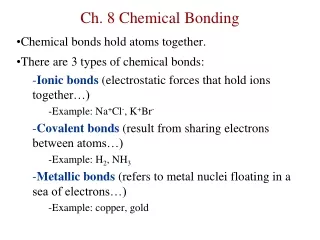
This chapter explores the essential principles of chemical bonding, focusing on electronegativity and the nature of ionic and covalent bonds. The electronegativity scale determines how atoms attract electrons, influencing bond strength and character. It distinguishes ionic bonds, formed by electron transfer between atoms, from covalent bonds, where electrons are shared. The chapter also delves into the characteristics of ionic and covalent compounds, the concept of bond lengths and angles, and the roles of different types of atomic radii, including van der Waals radii.

Understanding Chemical Bonding: Electronegativity, Ionic, and Covalent Bonds
E N D
Presentation Transcript
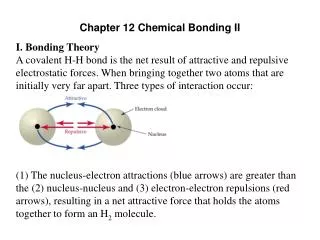
Ch 12 Chemical Bonding Bonds formed betw atoms depend on e- config & attraction the atoms have for e-’s - varies systematically
12.1 Electronegativity • - the relative tendency of an atom to attract e-’s to itself when it’s bonded to another atom • Values assigned to elems on the basis of experiments
12.1 Electronegativity • Electroneg diff betw atoms incr as bond strength incr • Electroneg.’s are influenced by same factors that affect ionization energies & e- affinities • Follow the same trends • Fr – lowest electroneg, F – highest • \ in bonds w/ F, bonding e-’s are drawn closer to F than the other atom
12.1 Electronegativity • In a rxnbetw 2 elems, relative attraction for e-’s determines how they react • Electroneg scale determines this attraction
12.2 Bond Character • If electroneg diff is high, atoms transfer e-’s to form ionic bonds • Held together by electrostatic (+ & - ) attraction • If electroneg diff is small, atoms share e-’s to form covalent bonds. • Amt of transfer depends on electroneg diff betw 2 atoms • If electroneg diff < 1.67, for covalent bonds • If electroneg diff > or = 1.67, form ionic bonds • All bonds have some charact. of both ionic & covalent
12.3 Ionic Bonds • When e-’s are tranferred from 1 atom to the other, (+) & (-) ions are formed • When brought close together, the attractive force betw them holds the ions together • Ionic Bond – the electrostatic force that holds 2 ions together due to differing charges
12.3 Ionic Bonds • Ionic comps have high melting pts, can conduct electricity in molten state, are usually soluble in water, & usually crystallize as sharply defined particles.
12.4 Ionic Radii • - found from experimental data & simplifying assumptions • Internuclear Distance – in a crystal – found by adding the radii of 2 ions in a comp • Can also be used as bond length in a molec • Or bond axis • Radii are not fixed values • 1. fuzziness of e- cloud • 2. effect ea ion has on neighboring ions
12.5 Covalent Bonds • - shared pair of e-’s • Covalent comps have low melting pts, do not conduct electricity, & are brittle • Molecule – particle resulting from 2 or more atoms bonding covalently • Bond Axis – line joining the nuclei of 2 bonded atoms in a molecule • Bond Angle – angle betw 2 bond axes in a molec.
12.5 Covalent Bonds • Bond Length – distance betw nuclei along bond axis • Not fixed – bond acts like a stiff spring • Atoms vibrate as though bonds were strectching & shrinking • Bonds also undergo bending, wagging, & rotational vibrations • All cause bond angles & lengths to vary • \ bond lengths & angles are average values
12.5 Covalent Bonds • Chemists use infra-red spectroscopy to determine molecular structure & vibrations of molecules. • Using IR spectrum, can compute bond strengths & determine much about how & where specific atoms are bonded in a molec. • Microwave radiation affects rotation of molecs • Can also determine bond lengths & bond angles
12.6 Covalent Radii • It’s possible to determine internucleardistbetw 2 bonded atoms • For IClit is 230 • Cl2 is 199, I2 is 266 – ½ of ea of these may be used for the radii of ea atom & their sums are the bond dist of ICl. • Covalent radii are only approximate • Useful in predicting bond lengths in molecs
12.7 Polyatomic Ions • - consist of 2 or more atoms covalently bonded together and possessing an overall charge • Form ionic bonds like other ions • Most are negative (exception – NH4)
12.8 Van der Waals Radii • There is a certain minimum distance maintained betw atoms which are not bonded to ea other • E- clouds of ea atom repel ea other • When free atoms or molecs collide, they act as if they had a rigid outer “shell”. • The “shell” limits how close other atoms or molecs may come • Bonded atoms are closer together than unbonded atoms.
12.8 Van der Waals Radii • The radius of this imaginary rigid shell is called Van der Waals Radius • The minimum dist maintained betwnonbonded atoms or atoms on adjacent molecs • Larger than covalent radius of bonded atoms
12.9 Summary of Radii • Studied 4 types of radii: • Atomic • Ionic • Covalent • Van der Waals
12.9 Summary of Radii • Atomic Radii – measured in 2 ways • 1. Meas on individual atoms in gaseous state • Atoms unaffected by neighboring atoms • 2. Meas on atoms in metallic crystals • Neighboring atoms have large effect • These 2 methods won’t give the same results
12.9 Summary of Radii • Ionic Radii – differ from atomic radii bec of loss or gain of e-’s
12.9 Summary of Radii • Covalent & Van der Waals Radii – vary greatly bec of wide range of atoms which can be bonded together • Covalent radii is expected to be less than atomic radii • When an atom is bonded to more than 1 other atom, e- cloud may be distorted • May make covalent radius larger than atomic radius • Same thing happens w/ Van der Waals radii • Radii are used to predict internucleardistbetw atoms.
12.10 Special Properties of Metals • Metals form crystals in which ea metal atom is surrounded by 8 or 12 neighboring metal atoms • Form when atoms crowd together and outer level orbitals overlap • E-’s can easily move from 1 atom to another • These e-’s are called delocalized electrons. • Not held in 1 place – “float” around the crystal
12.10 Special Properties of Metals • If an electric field is applied, e-’s will flow thru the metal, creating electric current • Delocalized e-’s interact w/ light creating luster. • Metalic Bond – constituted by the delocalized e-’s holding metallic atoms together
12.10 Special Properties of Metals • Properties of metals are determined by the # of outer e-’s available • Group 1 - 1 e- available - soft • Group 2 - 2 e-’s available - harder • Transition metals – d e-’s take part in metallic bond • Many are very hard & stron • Groups 3-6 – 3 to 6 delocalized e-’s • Groups 7-10 - 6 delocalized e-’s • Not all d e-’s are involved in the bond
12.10 Special Properties of Metals • It is possible to strengthen some metals by combining them w/ others to form alloys.