
The Semantic Web
E N D
Presentation Transcript
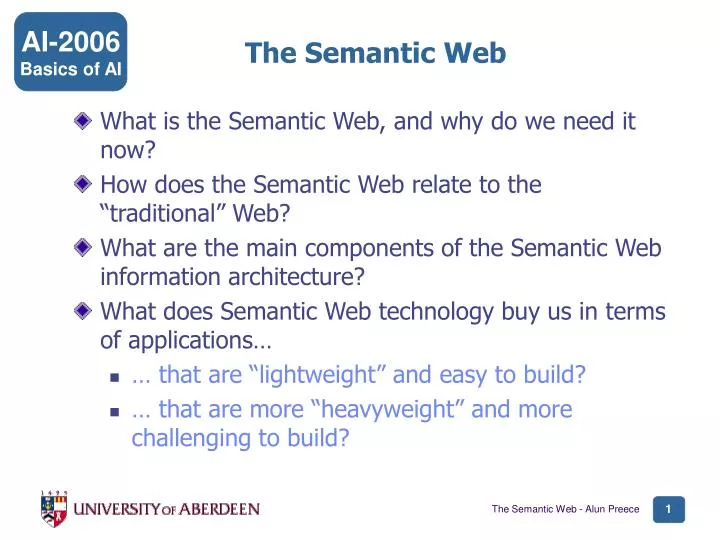
The Semantic Web • What is the Semantic Web, and why do we need it now? • How does the Semantic Web relate to the “traditional” Web? • What are the main components of the Semantic Web information architecture? • What does Semantic Web technology buy us in terms of applications… • … that are “lightweight” and easy to build? • … that are more “heavyweight” and more challenging to build? The Semantic Web - Alun Preece
What is the Semantic Web? “The Semantic Web is an extension of the current web in which information is given well-defined meaning, better enabling computers and people to work in cooperation.” Tim Berners-Lee, James Hendler, Ora Lassila, The Semantic Web, Scientific American, May 2001 • Aim: to create a network of machine-processable resources • Existing in parallel with the current World Wide Web • Enables software to carry out tasks on users' behalf • Moving from a Web of "finding things" to a Web of "doing things" The Semantic Web - Alun Preece
The problem with the HTML Web • A typical homepage, today: <table width="100%" border="0" cellspacing="0" cellpadding="10"> <tr bgcolor="#CCFFFF"> <td> <b>Alun Preece</b><br/> <b>Senior Lecturer</b> </td> <td> <div align="right"> Email: <a href="mailto:apreece@csd.abdn.ac.uk">apreece@csd.abdn.ac.uk</a><br/> Phone: +44 1224 272291 <br/> Fax: +44 1224 273422 </div> </td> </tr> </table> A search for “Alun Preece’s fax no.” gets no help from the HTML markup The Semantic Web - Alun Preece
Doesn’t XML solve this problem? <Person ID="apreece"> <name>Alun Preece</name> <mboxresource="mailto:apreece@csd.abdn.ac.uk" /> <phoneresource="tel:+44-1224-272291" /> <phoneresource="fax:+44-1224-273422" /> </Person> <Xfgpds ID="apreece"> <ghew>Alun Preece</ghew> <ngreresource="mailto:apreece@csd.abdn.ac.uk" /> <hytcxresource="tel:+44-1224-272291" /> <hytcxresource="fax:+44-1224-273422" /> </Xfgpds> • With XML, custom sets of tags can be defined, which can be: • “styled” into conventional HTML • processed directly by software - so can be queried… XML is just syntax - the tags don’t mean anything! The Semantic Web - Alun Preece
The Semantic Web <Person ID="apreece"> <name>Alun Preece</foaf:name> <mboxresource="mailto:apreece@csd.abdn.ac.uk" /> <phoneresource="tel:+44-1224-272291" /> <phoneresource="fax:+44-1224-273422" /> </Person> • XML alone is not enough - the XML tags need a defined semantics, to make them meaningful • Formally, to relate the tag symbols to the things they represent in the real world • So the markup becomes a model of the real world The Semantic Web - Alun Preece
Two Webs in parallel • The Semantic Web is not a replacement for the current Web • Semantic markup is designed to exist alongside HTML markup - often in the form of metadata (data that describes other data) • Humans will continue to view the HTML • Software can process the Semantic markup • Hence the W3C’s aim: “better enabling computers and people to work in cooperation” • (Because the Semantic markup is in XML, it is possible to generate HTML from it…) The Semantic Web - Alun Preece
Web/Semantic Web example http://www.csd.abdn.ac.uk/~apreece/index.html http://www.csd.abdn.ac.uk/~apreece/index.rdf The Semantic Web - Alun Preece
Semantic Web architecture Trust Knowledge layers Logic/proof Digital sig Ontology (vocab) Info layers RDF + RDF Schema “The Syntactic Web”: XML + NS + XSD Data layers “Strings & things”: Unicode + URIs [Adapted from Semantic Web "layer cake" slide due to Tim Berners-Lee] The Semantic Web - Alun Preece
Data layers: Unicode, URIs, XML Like the “traditional Web” (in recent years), Semantic Web data is based on W3C-recommended standards: • Unicode for strings (in all languages) • URIs - Uniform Resource Identifiers - to name “things” • XML as the standard extensible markup language • XML Schema for a variety of primitive datatypes (integer, real number, string, date, URI, …) • XML namespaces to give global scope for tag names <rdf:RDF xmlns:vc="http://www.w3.org/2001/vcard-rdf/3.0#"> <rdf:Description rdf:about="http://www.csd.abdn.ac.uk/~apreece"> <vc:FN>Alun Preece</vc:FN> <vc:EMAIL>apreece@csd.abdn.ac.uk</vc:EMAIL> … The Semantic Web - Alun Preece
Information layer: RDF + RDFS • RDF - Resource Description Framework - is the foundation of the Semantic Web standards • RDF provides: • a simple semantic data model with classes (entities) & properties (relationships) • schema definition constructs (RDF Schema) to define simple vocabularies of terms • an XML syntax for marking-up RDF data • RDF is the best-developed aspect of the Semantic Web: • many RDFS vocabularies are currently available • a suite of software tools exists to process RDF The Semantic Web - Alun Preece
Sample RDF Schema fragment • An RDFS definition for a class called Person: <rdfs:Class rdf:ID="http://xmlns.com/foaf/0.1/Person" /> • RDFS definitions for three RDF properties - name, mbox (email address), and phone: <rdf:Property rdf:ID="http://xmlns.com/foaf/0.1/name"> <rdfs:rangerdf:resource= "http://www.w3.org/2000/01/rdf-schema#Literal" /> </rdf:Property> <rdf:Property rdf:ID="http://xmlns.com/foaf/0.1/mbox" /> <rdf:Property rdf:ID="http://xmlns.com/foaf/0.1/phone" /> • Note how all these terms are named globally with URIs The Semantic Web - Alun Preece
Sample RDF data fragment <rdf:RDF xmlns:rdf= "http://www.w3.org/1999/02/22-rdf-syntax-ns#" xmlns:foaf="http://xmlns.com/foaf/0.1/" xml:base= "http://www.csd.abdn.ac.uk/~apreece/foaf.rdf#"> <foaf:Person rdf:ID="apreece"> <foaf:name>Alun Preece</foaf:name> <foaf:mboxrdf:resource= "mailto:apreece@csd.abdn.ac.uk" /> <foaf:phonerdf:resource="tel:+44-1224-272291" /> <foaf:phonerdf:resource="fax:+44-1224-273422" /> … </foaf:Person> <rdf:RDF/> The Semantic Web - Alun Preece
Querying RDF • RDF statements can be parsed from the XML format into an RDF model, for example using Hewlett Packard’s Jena toolkit • Jena RDF models can be queried directly using the RDQL query language • Example, “retrieve the phone number(s) of the person whose name is ‘Alun Preece”’: SELECT ?y WHERE ( ?x, <foaf:name>, "Alun Preece" ) AND ( ?x, <foaf:phone>, ?y > ) USING foaf FOR <http://xmlns.com/foaf/0.1/> • (RDF can also be queried in XML RDF syntax using University of Aberdeen’s RDF Query-By-Example) The Semantic Web - Alun Preece
More than just a smarter Google • In addition to offering accurate searching, by querying, Semantic Web data enables many kinds of applications • Examples • charting communities of friends and colleagues • building collaborative community-oriented apps • information integration based on standard vocab • Web “push”: publish & subscribe • automated Web services • A lot can often be done with small amounts of semantic markup! The Semantic Web - Alun Preece
Six degrees of separation: FOAF • The Friend-Of-A-Friend (FOAF) vocabulary covers • entities: people, organisations, projects, documents • “identifying” details: mbox, homepage, phone, depiction • relationships between people: who knows who • We’ve already seen FOAF definitions for the Person class, and the name, mbox, & phone properties • The FOAF knows property: <rdf:Property rdf:about="http://xmlns.com/foaf/0.1/knows"> <rdfs:domainrdf:resource="http://xmlns.com/foaf/0.1/Person" /> <rdfs:rangerdf:resource="http://xmlns.com/foaf/0.1/Person" /> </rdf:Property> The Semantic Web - Alun Preece
FOAFnaut • FOAFnaut is a tool that browses knows links: The Semantic Web - Alun Preece
The need for ontologies • RDF is designed to be simple • To define more sophisticated vocabulary, we need to go one layer higher: to the ontology layer • The Semantic Web ontology language, OWL, extends RDF with some additional functionality • Concrete examples: • a Person must have at least one name • a Person must have exactly one age • the class Person is the disjoint union of the classes Man and Woman • an email address (mbox) belongs to only one Person • This last example is crucial to FOAF… The Semantic Web - Alun Preece
OWL: Web Ontology Language • Core of the World Wide Web Consortium’s Semantic Web activity • In various senses a successor to previous work on “Web-friendly” knowledge modelling languages • RDF & RDF Schema • DAML-ONT • OIL / DAML+OIL • W3C’s Web Ontology Working Group are a “who’s who” of the knowledge representation field • Released in early 2004 The Semantic Web - Alun Preece
XML, RDF & OWL • XML: universal syntax • XML Schema: defines structure of XML docs • RDF: datamodel for resource objects • RDF Schema: basic vocabulary for defining RDF classes & properties, and hierarchies of each • OWL: extended vocab for defining classes & properties, including • cardinality (e.g. minCardinality 1) • equality (e.g. equivalentClass) • relationships between classes (e.g. disjointWith) • characteristics of properties (e.g. FunctionalProperty) The Semantic Web - Alun Preece
OWL “species” • OWL Lite • “RDF-and-a-half” • Mainly intended for class hierarchies & simple constraints (cardinality 0 or 1, equality, …) • OWL DL (contains OWL Lite) • Description Logic theoretical properties • Intended where completeness & decidability are an issue • OWL Full (contains OWL DL) • Max expressivity; no computational guarantees • Supports “Web-scale” & “Web-style” KR&R The Semantic Web - Alun Preece
A little ontology goes a long way • FOAF uses OWL to define the mbox property: <rdf:Property rdf:about="http://xmlns.com/foaf/0.1/mbox"."> <rdf:typerdf:resource= "http://www.w3.org/2002/07/owl# InverseFunctionalProperty" /> </rdf:Property> • This definition means: “mbox is a personal mailbox, i.e. an Internet mailbox associated with exactly one owner” • This means, in database terms, the value of mbox acts as a primary key for Persons in the FOAF world - a unique ID The Semantic Web - Alun Preece
Ontology mapping • OWL can also be used to map one vocabulary to another • Example: the vCard EMAIL property is the same as FOAF’s mbox: <rdf:Property rdf:about= "http://www.w3.org/2001/vcard-rdf/3.0#EMAIL"> <owl:equivalentProperty rdf:resource="http://xmlns.com/foaf/0.1/mbox" /> </rdf:Property> • An OWL reasoner could use this equivalence to derive a value for some resource’s vcard:EMAILif it can find a value for foaf:mbox The Semantic Web - Alun Preece
Application: MusicFriends • MP3 file sharing among a community of friends • Uses FOAF RDF vocab for friend-to-friend links • Uses MusicBrainz RDF vocab for MP3 collections The Semantic Web - Alun Preece
Application : AKT 3store • Repository of over 10 million RDF statements • Covers entire UK computing science community The Semantic Web - Alun Preece
Application: RSS • RDF Site Summary (RSS) is an open framework for “publish and subscribe” applications, using RDF • Many news sites (and other sites with frequent updates) now provide RSS channels • By using a “newsfeed” tool, one can subscribe to RSS channels of one’s choosing • When new items are published in RSS/RDF format, subscribers are notified • Items can be anything with a URI • news stories • published documents • slides of talks… The Semantic Web - Alun Preece
RSS sample • RSS metadata for this tutorial: <rss:item rdf:about="http://www.csd.abdn.ac.uk/ ~apreece/Talks/AI2006BasicsOfAI TheSemanticWeb.ppt"> <rdf:typerdf:resource= "http://xmlns.com/foaf/0.1/Document" /> <rss:title>AI-2006 Basics of AI: The Semantic Web</rss:title> <rss:description>Slides for the AI-2006 Basics of AI Tutorial, on the Semantic Web</rss:description> <rss:link> http://www.csd.abdn.ac.uk/ ~apreece/Talks/AI2006BasicsOfAI TheSemanticWeb.ppt</rss:link> <dc:creator>Alun Preece</dc:creator> </rss:item> The Semantic Web - Alun Preece
Semantic Web services • The key features of the Semantic Web… • machine-processable data • standard vocabularies • compatibility with the “Web family” of standards • … makes the technology very appealing for automated Web services in all sectors: • E-business • E-science • E-health • E-governance Web services use Web standards to allow client software to call upon Web servers to carry out tasks - far more than just information retrieval… The Semantic Web - Alun Preece
Granite Nights service • Semantic Web service: helps a user to schedule a night out in Aberdeen • Sources of information, all in RDF: • Restaurants (uses standard ontology) • Cinema shows (uses standard ontology) • Pubs (uses a home-grown ontology) • Remembers and recalls user preferences - semanticprofiling • AI-based scheduler maps RDF data to constraints and produces valid schedules • Part of EU-funded Agentcities.NET project (Worldwide network of intelligent Web services) The Semantic Web - Alun Preece
Summary • The Semantic Web is exciting from several perspectives: • as a piece of AI / computing science technology • as a “new generation” for the Web • as a platform for diverse kinds of applications • It’s still the Web we know and love: • it co-exists with all our messy HTML, etc data • it’s a global system: URIs are universal! • it’s extremely open • it’s not too hard to get started… The Semantic Web - Alun Preece
Credits & Links • Work done at Aberdeen in collaboration with • Agentcities & Granite Nights: Gunnar Grimnes, Pete Edwards, Stuart Chalmers • MusicFriends: Robin Campbell • URIs: • W3C Semantic Web: http://www.w3.org/2001/sw/ • RDF & apps: http://www.w3.org/RDF/ • FOAF: http://www.foaf-project.org/ • FOAFnaut: http://jibbering.com/foaf/ • RDF-vCard: http://www.w3.org/TR/2001/NOTE-vcard-rdf-20010222/ • MusicBrainz: http://www.musicbrainz.org/MM/ • Jena toolkit: http://www.hpl.hp.com/semweb/ • Granite Nights: http://www.csd.abdn.ac.uk/research/AgentCities/compo/ • AKT 3store: http://triplestore.aktors.org/demo/AKTiveSpace/ The Semantic Web - Alun Preece