Understanding Intermolecular Forces: Types and Impact
Explore the forces between molecules in covalent substances, including dipole-dipole, hydrogen bonding, and dispersion forces. Learn how these intermolecular forces affect properties like melting points. Discover the significance and impact of intermolecular forces on chemical bonds.

Understanding Intermolecular Forces: Types and Impact
E N D
Presentation Transcript
Bonding model for covalent molecular substances • Bonding for covalent molecular substances falls into two categories • The strong forces of attraction which holds atoms together within molecules • The weak forces of attraction between molecules
Forces between molecules (intermolecular forces) • So far we have spoken about the forces or bonds between atoms e.g. covalent, ionic and metallic • Now we will learn about the forces between molecules or compounds are called intermolecular forces • Inter means between or among • Internet, interstate, international • What would Interstellar travel be?
Intramolecular forces • What would intramolecular forces be? • Forces within molecules e.g covalent, metallic or ionic • intra means within • Intrastate, intranet, intracellular • Most of the intermolecular forces we look at occur between covalently bonded molecules or covalent molecular substances
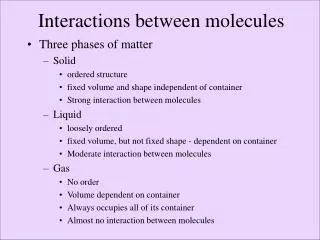
Overview • All matter is held together by force. • The force between atoms within a molecule is a chemical or intramolecular force. • The force between molecules are a physical or intermolecular force. • These physical forces are what we overcome when a chemical changes its state (e.g. gas liquid).
What causes intermolecular forces? • Molecules are made up of charged particles: positive nuclei and negative electrons. • When one molecule approaches another there is a multitude of forces between the particles in the two molecules. • Each electron in one molecule is attracted to the nuclei in the other molecule but also repelled by the electrons in the other molecule. • The same applies for nuclei
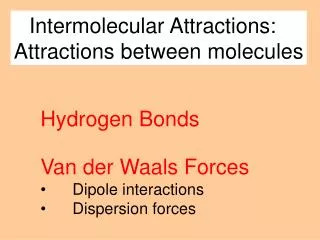
Types of Intermolecular forces • The three main types of intermolecular forces are: 1. Dipole-dipole attraction occur only btw polar molecules 2. H bonding – only with Hydrogen and Oxygen, Fluorine and Nitrogen) 3. Dispersion forces
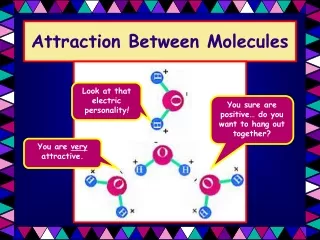
+ – H Cl + – + – + – 1. Dipole Dipole attraction or Dipole forces • Dipole forces occur between two polar molecules • The dipole force is the electrostatic attraction between the partial positive on one hydrogen on one molecule and the partial negative charge on the sulfur of another molecule. • One type of intermolecular force is dipole dipole
Draw the molecule and determine its shape using VSPER • Determine polarity within molecule • Determine how the molecules would interact
2. Hydrogen bonding • Hydrogen bonds are a special case of dipole forces • Hydrogen bonding occurs between molecules in which hydrogen is bonded to nitrogen, oxygen or fluorine • It occurs because N, F and O are very electronegative • This makes the molecule formed very polarised • The partial positive charge on hydrogen and the lone pair of electrons on N,F and O
Hydrogen bonds are stronger than dipole dipole attractions • We know this because of the difference in melting points of molecules with dipole dipole attractions and hydrogen bonding
3. Dispersion forces • Dispersion forces, or London forces, are the weakest of the intermolecular forces. • Dispersion forces occur between polar and non-polar molecules. They are generally weak and only considered in the absence of stronger intermolecular forces. • The greater the number of electrons within a molecule, the more significant the dispersion forces btw the molecule. • They occur between non-polar molecules.
Essentially they are the same as dipole forces- an electrostatic attraction between a partial positive charge and a partial negative charge. • However, the partial charges are more rare in nonpolar molecules. It is perhaps better to think of these interactions as those between a "temporary dipole" and an "induced dipole".
Stages for Dispersion Forces 1. There are two molecules 2. One molecule has a temporary dipole 3. The other molecule has an induced dipole
Strength of intermolecular forces • Hydrogen bonds are the strongest intermolecular force 2. Dipole Dipole Interactions 3. Disperson Forces are the weakest intermolecular force dispersion forces < dipole-dipole interactions < hydrogen bonds
How do intermolecular forces affect melting point? • When heat is applied to a solid, the molecules begin to vibrate more and more. The energy possessed by the molecules increases to the point that some intermolecular attractions are overcome.
How to measure the strength of a chemical bond? • One measure of the strength of a chemical bond is the energy required to break one of those bonds. • http://www.youtube.com/watch?v=IgcGuEwHHKY
Overview • Intermolecular forces (dispersion forces, dipole-dipole interactions and hydrogen bonds) are much weaker than intramolecular forces (covalent bonds, ionic bonds or metallic bonds) • dispersion forces are the weakest intermolecular force (one hundredth-one thousandth the strength of a covalent bond), hydrogen bonds are the strongest intermolecular force (about one-tenth the strength of a covalent bond).
Quiz • Which attractions are stronger: intermolecular or intramolecular? • Which is stronger a covalent bond or a dipole-dipole attraction? • Suggest some ways that the dipoles in London forces are different from the dipoles in dipole-dipole attractions.
Intramolecular are stronger. • A covalent bond is approximately100x stronger. • London forces • Are present in all compounds • Are transient in nature (dipole-dipole are more permanent). • London forces are weaker