Understanding Circular Motion: Centripetal Force and Acceleration
This guide explores the concepts of circular motion, focusing on centripetal force and acceleration. It discusses how velocity and speed are calculated using distance and time, leading to insights into real-world applications such as driving. The interplay between forces—gravity, tension, normal force, and friction—affects motion dynamics. Key formulas like F_net = ma and a = v²/R are introduced to help understand how different forces impact objects in circular paths. This foundational knowledge is essential for anyone studying physics or engineering.

Understanding Circular Motion: Centripetal Force and Acceleration
E N D
Presentation Transcript
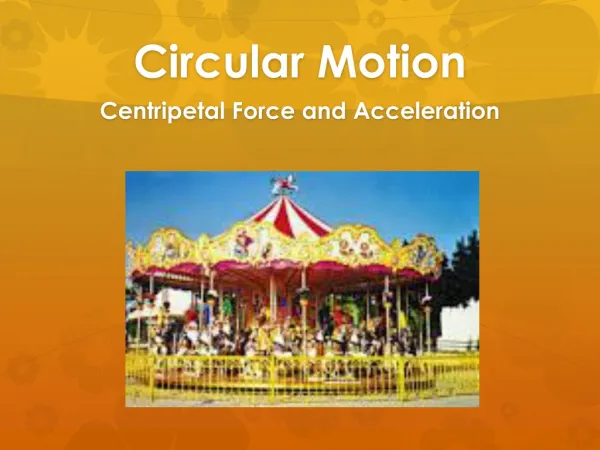
Circular Motion Centripetal Force and Centripetal Acceleration
Speed = distance / time = 2(3.14)(10.6)/17.3s = 0.0085 m/s Speed = distance / time = 2(3.14)(0.3095)/.285s = 6.82 m/s
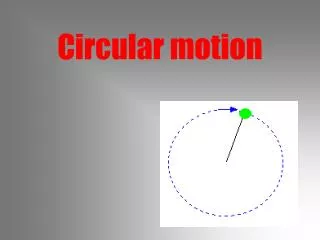
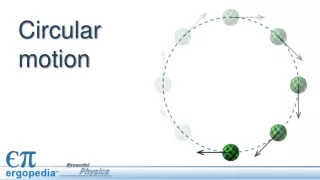
A v a v
Gravity Tension Normal Gravity Friction Friction + Normal Friction Gravity + Normal Normal - Gravity Normal
Fgrav Fnorm Fnorm Fgrav Fnet = Fnorm - Fgrav Fnet = Fnorm + Fgrav
Up Down > < Bottom The seat pushes upward on you more than you are use to!!! FALSE
110 N 20N 2.5 N 20N 11.25 down 22.5 down 45 UP UP a = v2/R Fnet = ma 90 a = 32/0.8 Fnet = 2x11.25 a = v2/R Fnet = ma a = 32/0.8 Fnet = 3x11.25
19,400 N 5,000 N 3,000 N 5,000 N 16 down 28.8 UP 8,000 down UP 14,400 a = v2/R Fnet = ma a = v2/R Fnet = ma a = 242/20 Fnet = 500x28.8 a = 82/4 Fnet = 500x16
655 N 24,600 N 6,000 N 6,000 N 8.9 down 31 UP down 5,345 UP 18,600 a = v2/R a = v2/R Fnet = ma Fnet = ma a = 302/29 Fnet = 600 x 31 a = 142/22 Fnet = 600 x 8.9