Simple Harmonic Motion
Explore the fascinating concept of simple harmonic motion (SHM) as demonstrated by the Tacoma Narrows Bridge's notorious collapse, known as "Gallopin' Gertie." This footage illustrates how motion can reoccur in a regular pattern, highlighting key principles like Hooke's Law, the importance of period and amplitude, and energy stored in springs. Engage with real-world applications including the behavior of springs and pendulums, as we uncover the forces at play in these periodic motions.

Simple Harmonic Motion
E N D
Presentation Transcript
YouTube - Color Footage of Tacoma Narrows YouTube - Tacoma Narrows Bridge Collapse "Gallopin' Gertie" Simple Harmonic Motion
Periodic Motion • Motion reoccurs in a regular pattern • Simple harmonic motion (SHM): force that restores the object to equilibrium is directly proportional to the displacement • Two important measurements: • Period (T): time to repeat one complete cycle • Amplitude: maximum displacement
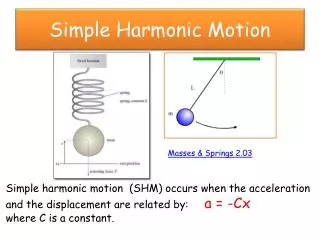
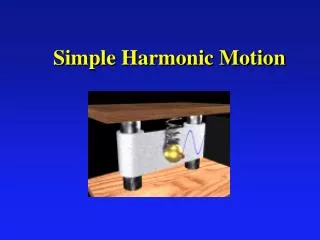
Mass on a Spring • Hooke's Law: force exerted by a spring is directly proportional to the amount the spring is stretched • F = -kx • PE=(1/2)kx2 • http://web.hep.uiuc.edu/home/mats/WCIA/wcia_030430_1.wmv
Springs! • Masses & Springs 2.02
Example • A spring stretches by 18 cm when a bag of potatoes weighing 56 N is suspended from the end. What is the spring constant? • Known: x=0.18m F=56N • F=-kx so k=F/x (the negative just means it's a restoring force) • k=56N/0.18m = 310 N/m
Example Continued • How much PE is stored in the spring? • PE=(1/2)kx2 • PE=(1/2)(310N/m)(0.18m)2 • PE=5 J
Now you try it! • A 560 N bicyclist sits on a bicycle seat and compresses the two springs that hold it up. The spring constant is 2.2 x 10⁴ N/m for each spring. How much is each spring compressed? • Know: F=560 N k=2.2 x 10⁴ N/m 2 springs • F=-kx or x=F/k and since 2 springs x=F/2k • X=1.3 x 10⁻² m
Period of a Spring • Mass attached to a spring exhibits simple harmonic motion • T= 2π√(m/k) • Frequency is inverse of period!
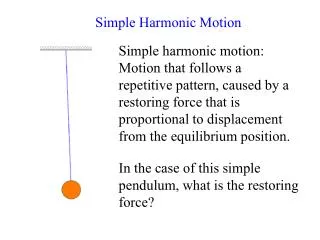
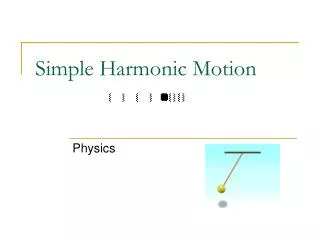
Pendulum • Object (bob) suspended by a string of length l • String exerts tension (force) and gravity exerts force • Period of a pendulum: T=2π√(l/g)
Sample Problem • A pendulum with length 36.9 cm has a period of 1.22 s. What is the acceleration of gravity at the pendulum's location? • Known: T=1.22 s l=0.369 m • T=2π√l/g so g=(2π)2l (T)2 • g=9.78 m/s2