Understanding Simple Harmonic Motion and Pendulum Dynamics
This article explores the principles of Simple Harmonic Motion (SHM) and periodic motion, detailing the forces, such as gravity and spring tension, that affect oscillation. We discuss the characteristics of SHM—restoring force, amplitude, period, and frequency—and how these concepts relate to pendulum dynamics. Special attention is given to damping effects and oscillation types, including small amplitude approximations and characteristics of physical pendulums. Applications and examples illustrate the underlying physics of these systems, providing a comprehensive overview of oscillatory motion.

Understanding Simple Harmonic Motion and Pendulum Dynamics
E N D
Presentation Transcript
Periodic Motion • defined: motion that repeats at a constant rate • equilibrium position: forces are balanced
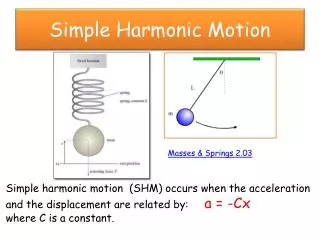
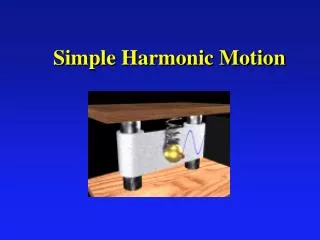
Periodic Motion • For the spring example, the mass is pulled down to y = -A and then released. • Two forces are working on the mass: gravity (weight) and the spring.
Periodic Motion • for the spring: ΣF = Fw + Fs ΣFy = mgy + (-kΔy)
Periodic Motion • Damping: the effect of friction opposing the restoring force in oscillating systems
Periodic Motion • Restoring force (Fr): the net force on a mass that always tends to restore the mass to its equilibrium position
Simple Harmonic Motion • defined: periodic motion controlled by a restoring force proportional to the system displacement from its equilibrium position
Simple Harmonic Motion • The restoring force in SHM is described by: Fr x = -kΔx • Δx = displacement from equilibrium position
Simple Harmonic Motion • Table 12-1 describes relationships throughout one oscillation
Simple Harmonic Motion • Amplitude: maximum displacement in SHM • Cycle: one complete set of motions
Simple Harmonic Motion • Period: the time taken to complete one cycle • Frequency: cycles per unit of time • 1 Hz = 1 cycle/s = s-1
1 1 f = T = T f Simple Harmonic Motion • Frequency (f) and period (T) are reciprocal quantities.
Reference Circle • Circular motion has many similarities to SHM. • Their motions can be synchronized and similarly described.
m T = 2π k Reference Circle • The period (T) for the spring-mass system can be derived using equations of circular motion:
m T = 2π k Reference Circle • This equation is used for Example 12-1. • The reciprocal of T gives the frequency.
Overview • Galileo was among the first to scientifically study pendulums.
Overview • The periods of both pendulums and spring-mass systems in SHM are independent of the amplitudes of their initial displacements.
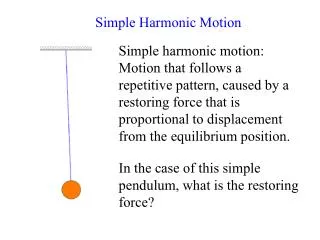
Pendulum Motion • An ideal pendulum has a mass suspended from an ideal spring or massless rod called the pendulum arm. • The mass is said to reside at a single point.
Pendulum Motion • l = distance from the pendulum’s pivot point and its center of mass • center of mass travels in a circular arc with radius l.
Pendulum Motion • forces on a pendulum at rest: • weight (mg) • tension in pendulum arm (Tp) • at equilibrium when at rest
Restoring Force • When the pendulum is not at its equilibrium position, the sum of the weight and tension force vectors moves it back toward the equilibrium position. Fr = Tp + mg
Restoring Force • Centripetal force adds to the tension (Tp): Tp = Tw΄+ Fc , where: Tw΄ = Tw = |mg|cosθ Fc = mvt²/r
Restoring Force • Total acceleration (atotal) is the sum of the tangential acceleration vector (at) and the centripetal acceleration. • The restoring forces causes this atotal.
Restoring Force • A pendulum’s motion does not exactly conform to SHM, especially when the amplitude is large (larger than π/8 radians, or 22.5°).
Small Amplitude • defined as a displacement angle of less than π/8 radians from vertical • SHM is approximated
l T = 2π |g| Small Amplitude • For small initial displacement angles:
l T = 2π |g| Small Amplitude • Longer pendulum arms produce longer periods of swing.
l T = 2π |g| Small Amplitude • The mass of the pendulum does not affect the period of the swing.
l T = 2π |g| Small Amplitude • This formula can even be used to approximate g (see Example 12-2).
Physical Pendulums • mass is distributed to some extent along the length of the pendulum arm • can be an object swinging from a pivot • common in real-world motion
Physical Pendulums • The moment of inertia of an object quantifies the distribution of its mass around its rotational center. • Abbreviation: I • A table is found in Appendix F of your book.
I T = 2π |mg|l Physical Pendulums • period of a physical pendulum:
Damped Oscillations • Resistance within a spring and the drag of air on the mass will slow the motion of the oscillating mass.
Damped Oscillations • Damped harmonic oscillators experience forces that slow and eventually stop their oscillations.
Damped Oscillations • The magnitude of the force is approximately proportional to the velocity of the system: fx = -βvx β is a friction proportionality constant
Damped Oscillations • The amplitude of a damped oscillator gradually diminishes until motion stops.
Damped Oscillations • An overdamped oscillator moves back to the equilibrium position and no further.
Damped Oscillations • A critically damped oscillator barely overshoots the equilibrium position before it comes to a stop.
Driven Oscillations • To most efficiently continue, or drive, an oscillation, force should be added at the maximum displacement from the equilibrium position.
Driven Oscillations • The frequency at which the force is most effective in increasing the amplitude is called the natural oscillation frequency (f0).
Driven Oscillations • The natural oscillation frequency (f0) is the characteristic frequency at which an object vibrates. • also called the resonant frequency
Driven Oscillations • terminology: • in phase • pulses • driven oscillations • resonance
Driven Oscillations • A driven oscillator has three forces acting on it: • restoring force • damping resistance • pulsed force applied in same direction as Fr
Driven Oscillations • The Tacoma Narrows Bridge demonstrated the catastrophic potential of uncontrolled oscillation in 1940.
Waves • defined: oscillations of extended bodies • medium: the material through which a wave travels
Waves • disturbance: an oscillation in the medium • It is the disturbance that travels; the medium does not move very far.
Graphs of Waves Waveform graphs Vibration graphs