
Exploring the Fascinating World of Waves: Types, Properties, and Phenomena
E N D
Presentation Transcript
WAVES By Hieronimus Fredy Sestywan
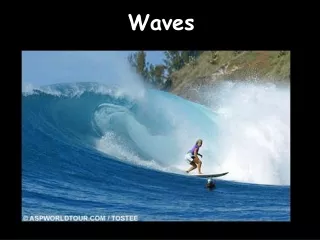
Waves Waves is the movement of oscilation Water wave Vibration of SHM
Properties of waves • Reflection • Refraction • Diffraction • Interference • Polarization
Types of waves • Based on its direction : longitudinal waves and transverse waves • Based on its medium : mechanical waves and electromagnetic waves • Based on its amplitude : standing waves and travelling waves
Longitudinal waves In a longitudinal wave, the vibrations are parallel to the line of motion of the wave Example : sound wave and slinki wave
Progressive waves A progressive wave is one in which the wave profile carries energy and momentum away from the source of disturbance Example : longitudinal wave and transverse wave
Velocity of waves Acceleration of waves
ANGLE OF PHASE, PHASE AND PHASE DIFFERENCE ANGLE OF PHASE PHASE PHASE DIFFERENCE
Stationary waves A stationary wave is formed when two waves of the same frequency and amplitude travelling in opposite directions, are superimposed example : stationary waves on vibrating wires ( Melde’s experiment)
ANTINODES NODES
ANTINODES NODES
VELOCITY OF WAVES BASED ON THE MEDIUM ON STRING ON WATER ON AIR ON SOLID
Movie Standing waves and Progressive waves
General equation of wave V = f x λ (waves velocity) E = ½ kA2 = 2π2f2mA2 = ½ mω2A2 (energy) I = 2 π2ρvf2A2 (waves intensity)