SOIL FORMATION
Explore the intricate process of soil formation, influenced by climate, organisms, relief, parent material, and time. Discover how weathering, physical and chemical processes shape soil properties and compositions.

SOIL FORMATION
E N D
Presentation Transcript
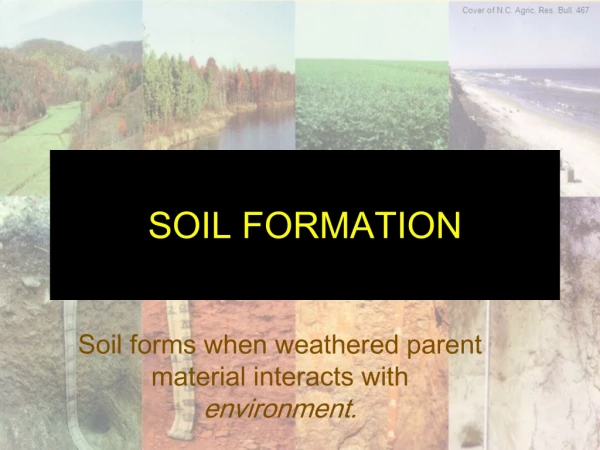
SOIL FORMATION Soil forms when weathered parent material interacts with environment.
weathering • Wearing parent material down • PHYSICALLY • CHEMICALLY
Physical (Mechanical): disintegration of parent material into smaller pieces increases surface area: surface area increases by about the same factor as particle size decreases.
Chemical (Biogeochemical) acts on surfaces: primary minerals are broken down and secondary minerals are formed.
Soil forms when weathered parent material interacts with the environment. What would constitute the ENVIRONMENT of a soil?
Soil carbonic acid (formed from LIFE in soil) extracts minerals from soil(which came from parent material)
How fast does soil form? Slow--------------------------------------Fast ~ 1 cm/1000 yr ~ 30cm/50yr Not very.
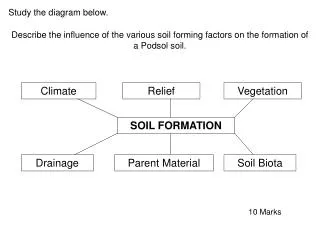
Hans Jenny • 1941: soil is open system, properties are functionally related; system changes when property(ies) change(s). • Jenny’s CLORPT equation s = ƒ (cl, o, r, p, t) He expanded on the ideas of Dokuchaev
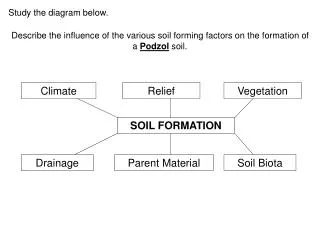
1. CLIMATE 2. ORGANISMS 3. RELIEF 4. PARENT MATERIAL 5. TIME
1. CLIMATE …determines speed, character of soil development: determines the type and rate of weathering determines living organisms and plants found in an area
components of climate : • 1. Temperature • -for every 10°C , biochemical rxn rates 2X • 2. Effective precipitation • (water that moves through entire soil column, including regolith) • -depth of water = depth of weathering • -water moves soluble & suspended materials
(Fig. 2.15) High temperatu
Temperature and humidity increase the depth of weathering. Humid, tropics High latitude Dry, SW US Humid, SE US
Effective precipitation -a) seasonal distribution -b) temperature, evaporation -c) topography -d)permeability
a) Seasonal distribution of precipitation: Location B 600 mm/yr Location A 600 mm/yr 100mm 50mm 6 rainy months only Every month
b) Temperature and evaporation: Location A hot Location B cool High evapotranspiration Low evapotranspiration 600 mm 600 mm Lower effective ppt Higher effective ppt
Topography: concave or bottom of slope (receiving) level slope
2. Organismsplant and animal (Living plants and animals on and in soil) -sources of organic matter -nutrient recycling -vegetation prevents erosion -type of vegetation influences soil type -base pumping -
Base pumping Deciduous trees are more effective base pumpers than conifers . -needles are hard to break down -basic cations leach away: soil is acidic -deciduous litter is easy to break down -cations (bases) are released so surface soils are not acidic
Macroanimals (insects, mammals, gastropods, earthworms) • mix, bind soil; create channels for air, water
Macroanimals (insects, mammals, gastropods, earthworms) • mix, bind soil; create channels for air, water • Microanimals (nematodes, protozoa)
Macroanimals (insects, mammals, gastropods, earthworms) • mix, bind soil; create channels for air, water • Microanimals (nematodes, protozoa) • Macroplants (the green plants) • provide organic matter, roots create channels, adsorb nutrients, release CO2, stabilize, protect from erosion
Macroanimals (insects, mammals, gastropods, earthworms) • mix, bind soil; create channels for air, water • Microanimals (nematodes, protozoa) • Macroplants (the green plants) • provide organic matter, roots create channels, adsorb nutrients, release CO2, stabilize, protect from erosion • Micro “plants” (fungi, bacteria, actinomycetes, algae) • decomposers
3. Relief/Topography • important for rate of runoff, erosion, drainage
Flat valley floors and flat ridge tops: soil accumulates; (deepening>removal) Slopes: (removal> deepening)
4. Parent Material Determines: • texture, • types of weathering, • mineral make-up
Some Physical Weathering Processes: 1. Freeze/thaw
Physical: 1. Freeze/thaw 2. Exfoliation
Physical: 1. Freeze/thaw 2. Exfoliation 3. Abrasion
Physical: 1. Freeze/thaw 2. Exfoliation 3. Abrasion 4. Salt wedging