PROGRESS IN SAR SHIP DETECTION AND WAKE ANALYSIS
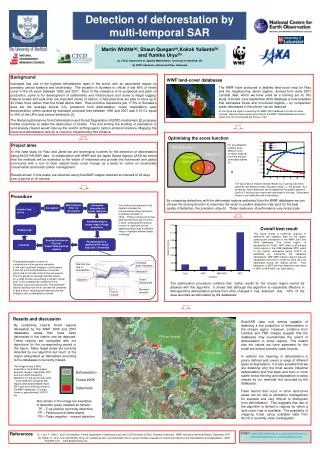
This report presents advancements in ship detection using Synthetic Aperture Radar (SAR) and wake analysis, detailing a new K-distribution approximation method that reduces computational complexity. It covers challenges in parameter estimation, implications for detecting ships and their wakes, and findings from studies utilizing RADARSAT-2 images and Automatic Identification System (AIS) data. Key conclusions highlight the significant factors affecting wake visibility, such as wind speed, ship speed, and propeller configuration, important for improving detection probability and reducing false alarms.

PROGRESS IN SAR SHIP DETECTION AND WAKE ANALYSIS
E N D
Presentation Transcript
PROGRESS IN SAR SHIP DETECTION AND WAKE ANALYSIS J.K.E. Tunaley London Research and Development Corporation, 114 Margaret Anne Drive, Ottawa, Ontario K0A 1L0 1-613-839-7943 http://www.london-research-and-development.com/
OUTLINE • K-distribution • New simple asymptotic approach for large threshold values • Parameter estimation difficulties • Implications for ship detection • Ship Wakes • Study started at RMC, Kingston using RADARSAT-2 images, AIS, plus other information. • Findings and implications for MDA • See Web site for papers www.london-research-and-development.com
K-Distribution • Ships are bright blobs in SAR images • Need statistics of clutter background for CFAR • K-D excellent description of radar clutter • Basis is modulated complex Gaussian clutter • Physical / statistical basis incomplete • Modulating distribution assumed gamma • Modified Bessel functions of 2nd kind. • Computational complexity • Approximation for tail values needed www.london-research-and-development.com
K-D APPROXIMATION • Low PFA: interested in tail of distribution • Represent pdf as an integral • Use steepest descents • Accurate to better than 0.1% (PFA = 10-9) • Not sensitive to statistics of modulation • Implies that K-D has sound physical basis • Basic code can be implemented in < 18 lines of C# or C++. www.london-research-and-development.com
THRESHOLD COMPARISON www.london-research-and-development.com
PARAMETER ESTIMATION • Need to estimate mean and order parameter • Number of looks is given • Can estimate optimal performance • Uses Fisher information (Cramer Rao) • Parameter variance depends on number of independent samples, N • Need to consider bias • Note: Parameters need not be integer www.london-research-and-development.com
OPTIMUM MEAN INTENSITYCramer Rao Bound #Samples N = 256 L = 1 L = 4 L = 10 Spiky Rayleigh www.london-research-and-development.com
SDs USING MOM: N = 1000 Optimum Practical L = 1 Black; L = 4 Red; L = 10 Yellow www.london-research-and-development.com
PRACTICAL THRESHOLD N = 100 Ideal N = 1000 N = 10000 L = 4 Rayleigh Spiky www.london-research-and-development.com
CONCLUSIONS (1) • K-distribution approximation will reduce computational complexity for ship detection • Methodology adds support to use of K-distribution • Insensitivity to modulating distribution • Mean of K-distribution can be estimated as usual • Parameter variance may bias detection thresholds by large factors if N < 1000 • Very important in spiky clutter • Without correction, PFA may increase by orders of magnitude • If corrected, probability of ship detection is reduced • Adaptive pixel block size (N) is desirable in variable clutter www.london-research-and-development.com
SHIP WAKES • Turbulent wake study with Dan Roy at RMC • RADARSAT-2 images • AIS • Other ship information about propulsion system (Ship owners, Internet, etc.) • Analysis (60 ships) includes • Twin screws/single screw • Left/right handed screws www.london-research-and-development.com
RMC RESULTS • Wakes not usually visible when wind speed U > 6 m/s • Ship speed V is important: if U < 6 m/s && V > 5 m/s, 80% of wakes are visible • Bright line on side of wake consistent with propeller flows (swirling and axial) and wind direction • Wakes from shallow twin screws tend to be visible www.london-research-and-development.com
RSAT-2: QUEEN OF ALBERNI Data supplied by MDA Corporation www.london-research-and-development.com
Q of A Parameters www.london-research-and-development.com
COMBINED SWIRLING AND AXIAL WAKE • Consider both linear and angular momentum in propeller wake • Modify Prandtl’s approach to theory • Estimate fluid linear and angular momentum using standard engineering methods • Apply to Queen of Alberni (BC Ferries) www.london-research-and-development.com
Q of A Wake Diameter Combined Swirling Axial www.london-research-and-development.com
Queen of Alberni Maximum Surface Flow Speed Axial Swirling www.london-research-and-development.com
Deep Screw CaseMaximum Flow Speed Axial Swirling www.london-research-and-development.com
CONCLUSIONS (2) • Surface flows in the turbulent wake can be large compared with Bragg group velocity • Expect significant radar wake visibility for long distances • Swirling component dominates axial flow immediately astern and especially when screws are deep • Wake characteristics can be used to verify ship • Note: • Hydrodynamic wake width is only one factor in radar wake width. Others are flow speeds, ambient wind and waves, radar effects and geometry. www.london-research-and-development.com
END Thank You All! www.london-research-and-development.com