Understanding Human Muscle Movement
Explore the muscular system, types of muscles, how they work, voluntary vs. involuntary movement, and muscle pairs. Critical thinking activities on muscle function and bone composition included. Learn how to conduct hands-on experiments to enhance understanding.

Understanding Human Muscle Movement
E N D
Presentation Transcript
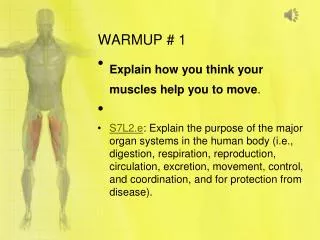
WARMUP # 1 • Explain how you think your muscles help you to move. • S7L2.e: Explain the purpose of the major organ systems in the human body (i.e., digestion, respiration, reproduction, circulation, excretion, movement, control, and coordination, and for protection from disease).
Muscular System pg. 588 • I. Kinds of Muscles • A. Three Major Muscles • 1. What are the 3 kinds of muscles and where are they located? • 2. Distinguish between voluntary and involuntary muscle movement. • 3. Explain how the muscles in your arm work. • 4. Describe how skeletal muscles work. • 5. Describe how muscles work in pairs.
CRITICAL THINKING ACTIVITIES • I. Identify the problem. • CT 1: How do muscles work? • CT 2: What are bones made of? • II. What materials did you use? • CT 1:Index card, rubber band, straw, tape, muscle diagram CT 2: bone in vinegar, knife and worksheet • III. Make a hypothesis. • _______________________________________________ • IV. What is the procedure? • CT 1: Tape straw to muscle diagram and add rubber band. • CT 2: Cut bone with a knife and describe what you see. • V. What were the conclusions?